

The most expensive mistake in business is building something before anyone has agreed to buy it. Validation is the process of finding out whether the problem you think you are solving is real and whether people will pay for your solution, before you invest in building it.
What follows are ten methods, ordered by how much they cost and how much they teach.
Why Opinions Are Worthless
Asking people whether they would buy your product produces almost no useful information. People are polite, and polite people say yes. The only validation that counts is behaviour: someone giving you money, time, or a commitment.
This is the single most important principle in the list. Everything else follows from it.
The Top 10 Methods
1. Talk to Ten Potential Customers
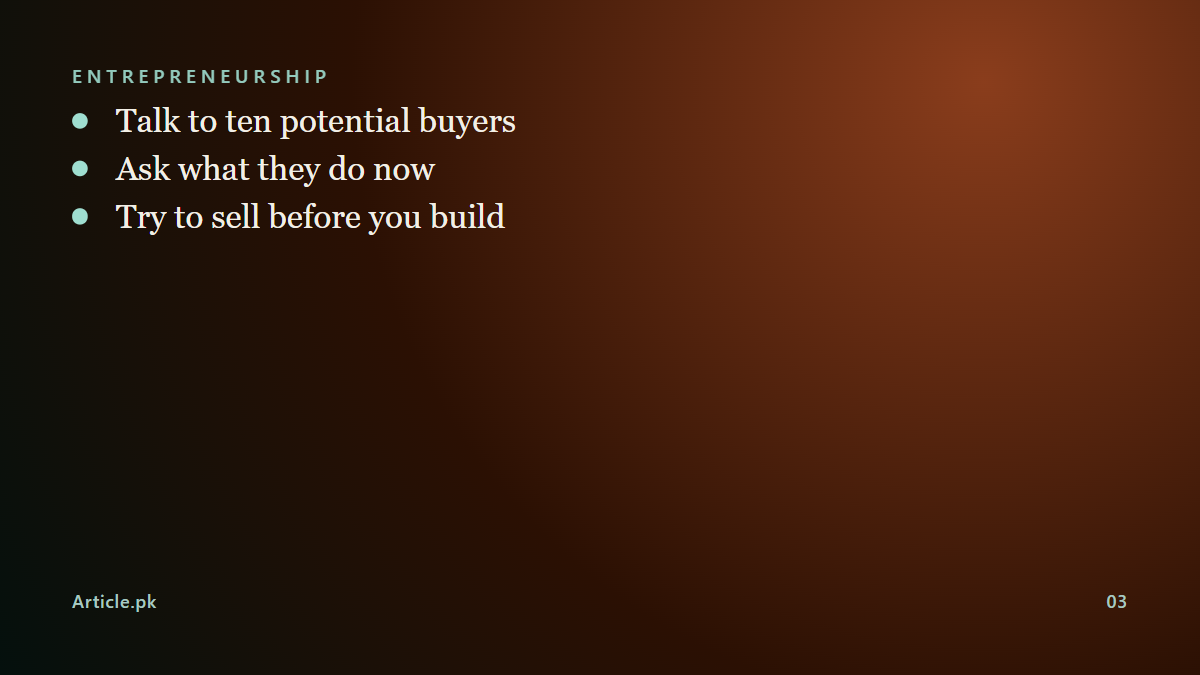
Not about your idea. About their problem. What do they currently do about it, what does it cost them, and what have they tried. If they are not already spending time or money on the problem, it is not a real problem.
The question \"would you buy this\" is useless. The question \"what do you do now\" is everything.
2. Sell Before You Build
Describe the product, set a price, and ask for the money. If they pay, you have a business. If they do not, you have saved months.
A landing page with a buy button and a waitlist is enough to start.
3. Run a Small Ad Campaign
Spend a modest amount on ads pointing to a landing page. The click-through rate and the conversion to email or payment tell you whether the market responds to the offer.
Thirty dollars of ads teaches more than thirty conversations.
4. Build a Concierge Version
Deliver the service manually before automating it. If you are building software, do the work by hand for five clients. You learn what they actually need versus what you assumed.
Most products change significantly after the first five manual deliveries.
5. Offer a Pre-Order
Take orders for a product that does not exist yet, with a clear delivery date and a refund if you do not deliver. Pre-orders are the strongest possible signal.
If nobody pre-orders, you have your answer cheaply.

6. Test Pricing Directly
Quote different prices to different prospects and see where resistance appears. The price people actually pay is often higher than you expect and the resistance point is usually lower than your fear.
Price is part of the product. Test it as seriously as the features.
7. Check Search Volume
Are people actively searching for a solution to this problem? Search data is a proxy for demand, and it is free.
Low search volume does not kill an idea, but it changes the marketing strategy from inbound to outbound.
8. Analyse Competitors
If nobody is solving this problem, ask why. It is usually because the problem is not painful enough, or the market is too small, or the economics do not work.
Competition is usually a sign of a real market.
9. Run a Smoke Test
Create a product page for something that does not exist and measure interest. This is the fastest way to test positioning and messaging.
Be transparent if anyone asks. The test is about demand, not deception.
10. Build a Minimum Viable Product
The smallest version of the product that delivers the core value. Not a prototype, not a demo — something a customer can use and pay for.
If the MVP does not sell, the full product will not either.
The Seven-Day Validation Plan
Day one: write the offer in one sentence and a price. Day two: list ten potential buyers. Days three to five: contact them and ask about their current solution. Day six: ask two of them to pay, even a deposit. Day seven: decide.
If nobody will pay a small amount now, a larger amount later will not appear. That is the whole test, and it costs nothing but nerve.
Mistakes That Waste Validation
Asking friends and family, who will lie to be kind. Building a prototype before talking to anyone. Treating positive feedback as validation. And confusing interest with intent.
Interest is free. Intent costs money. Only one of them builds a business.
What to Do With a Failed Validation
A failed validation is not a failure. It is information that cost you a week instead of a year. The question is what to do with it.
First, identify what specifically failed. Was the problem not real, was the price wrong, or was the solution not credible? Each points to a different next step.
If the problem is real but your solution is wrong, talk to the people who rejected it and ask what they would buy instead. Their answers are your next idea.
If the problem is not real, move on without regret. Most ideas are not real problems, and discovering that quickly is the whole point of validation.
And keep the conversations. The people who talked to you are your first customers when you find the right idea, because they already trust you.
The Questions That Actually Matter
Most validation conversations fail because the questions are wrong. Asking \"do you like this idea\" produces polite agreement. Asking \"what did you last spend money on to solve this problem\" produces truth.
The useful questions are: what is the hardest part of this for you, how are you solving it now, how much does that cost, and what would make you switch. Each one is about behaviour, not opinion.
And the most useful question of all: why have you not already solved this yourself. The answer tells you whether the problem is real or whether you are solving something the customer does not actually care about.
Write the answers down immediately. Memory edits them within an hour, and the edits always make the idea look better than it was.
How to Talk to Customers Without Leading Them
The most common mistake in customer interviews is describing your idea and watching for enthusiasm. Enthusiasm is free and meaningless. The goal is to learn about their life, not to pitch.
Start with their last attempt to solve the problem. \"Tell me about the last time you tried to do X.\" Their answer reveals whether the problem is real, how they currently handle it, and what they would change.
Then ask what they spent. Time, money, or both. If the answer is nothing, the problem is not painful enough to build a business on.
And ask why they stopped. The reason they gave up on their last solution is the gap your product needs to fill.
Take notes in their words, not yours. Paraphrasing edits their meaning toward your assumption, and your assumption is probably wrong.
The Bottom Line
Validate with behaviour, not opinions. Ask for money before you build, and let the answer decide.








Comments 0
Sign in to join the conversation.
No comments yet. Be the first to say something.