

The Student Guide: How to Manage Time in Ramadan Without Burning Out
 Ramadan Timing for students
I remember staring at the same page of my school book for an hour while fasting. I learned absolutely nothing. I felt like a failure. But later, I learned that the problem was not me. It was my plan.
If you are a student, you probably know this "Ramadan problem" very well. On one hand, you want to pray Taraweeh, read the Quran, and enjoy the holy month. On the other hand, school does not stop. You still have homework, projects, and final exams. It does not matter to your teachers that you have been awake since 3:30 AM.
It is very easy to feel stressed. You feel tired during the day, and then you feel guilty at night because you did not study enough. But what if we changed how we think about this?
Instead of thinking Ramadan ruins your study time, look at it as a training camp. Fasting teaches you discipline, patience, and strong focus. These are the exact skills a successful student needs.
In this easy guide, we will break your day into "energy zones," show you how to fix your sleep, and give you a daily schedule. If you want to know how to balance school and Ramadan, you are in the right place. Let us start.
Part 1: A New Way to Think
Before we talk about schedules, we need to fix how you think about studying. You cannot use your normal daily routine during Ramadan. It will not work.
Good Studying over Long Studying
On a normal day, you might sit in the library for six hours. In Ramadan, trying to do this will make you too tired. You must accept that you will study for fewer hours, but with much better focus. Three hours of deep work early in the morning is much better than six hours of sleepy reading in the afternoon.
The Blessing (Barakah) of Time
In Islam, we believe in "Barakah," which means blessed time. When you have a good intention—like studying so you can get a good job and help your family—God puts blessings in your time. A little bit of hard work can give you big results.
Focus on the Most Important Things
During Ramadan, do not try to read every single word in your book. This is the time to focus only on the most important topics. Look at old exams, review your main notes, and test yourself. Keep it simple.
Part 2: Your Ramadan Energy Zones
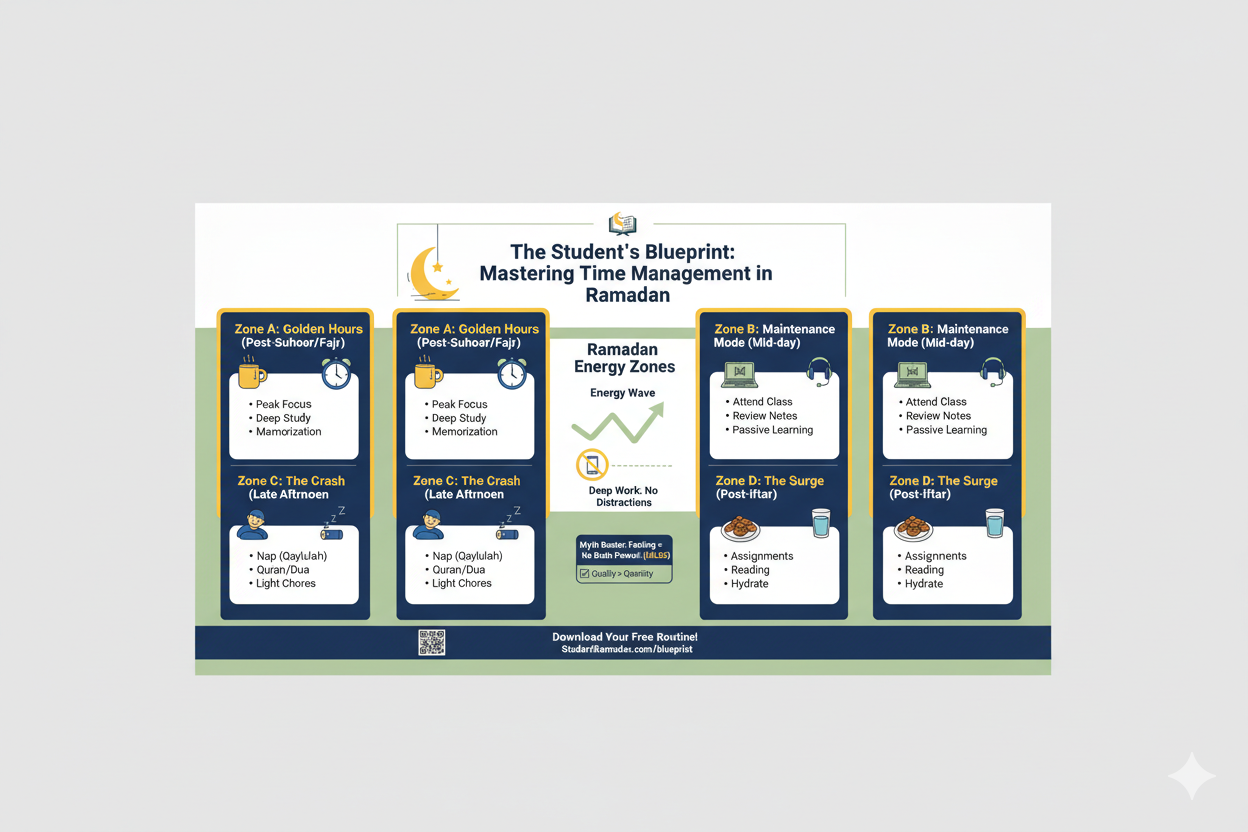
You cannot fight your body while fasting. Instead, you need to work with your energy levels. We can divide your day into four simple zones:
Zone A: The Golden Hours (Right after Suhoor and Fajr)
-
Energy Level: Very High.
-
Why?: Your stomach is full from Suhoor, you drank water, and the house is quiet.
-
What to do: This is the best time to study during Ramadan. Do your hardest homework here. Practice math, write essays, or memorize hard subjects. Do not go back to sleep right after Fajr!
Zone B: The Slow Time (Morning to Early Afternoon)
-
Energy Level: Medium but dropping.
-
Why?: As the day goes on, you start to feel a little hungry and tired.
-
What to do: Do easy tasks. Attend your classes, listen to teachers, organize your notes, or study with friends.
Zone C: The Crash (Late Afternoon)
-
Energy Level: Very Low.
-
Why?: You are now very hungry and thirsty. Your brain feels foggy.
-
What to do: Accept that you need to rest. Do not force yourself to study hard things right before Iftar. Use this time to read Quran, make Dua, help around the house, or take a nap.
Zone D: The Energy Return (After Iftar to Isha)
-
Energy Level: High (but only if you eat healthy!).
-
Why?: You finally have food and water in your body again.
-
What to do: This is your second study time. Finish your daily homework or read.
-
Be Careful: Do not eat too much heavy, fried food at Iftar. If you eat too much, you will feel very sleepy and will not be able to study at all.
Part 3: Your Action Tools
Now that you know your energy zones, here are some simple tips to help you succeed:
Myth Buster: "I can't study while fasting."
Fact: This is not true! When you fast, your brain actually gets very clear and focused. The sleepy feeling usually comes from not drinking enough water the night before, or not getting enough sleep.
How to Sleep
You cannot get 8 hours of sleep all at once anymore. To survive, try the "4 + 2 Plan." Sleep for about 4 hours at night (like 11:30 PM to 3:30 AM). Then, take a 2-hour nap in the afternoon (like 2:00 PM to 4:00 PM). This gives your brain the rest it needs.
Put the Phone Away
Because you have less time to study, you cannot waste it. Put your phone in another room. Study hard for 45 minutes, then take a 15-minute break.
What to Eat at Suhoor
What you eat at 4:00 AM changes how you feel at 2:00 PM. Eat foods that give slow energy, like oats, eggs, whole-grain bread, and yogurt. Do not eat sugary cereals or salty food. Sugar makes you crash, and salt makes you very thirsty. Make sure to drink plenty of water at night and early morning.
Find a Good Place
If your house is loud before Iftar, go somewhere else. Study at the library or stay in the quiet mosque after Asr prayer. If you study in your bedroom, keep your desk clean.
Part 4: A Sample Daily Schedule
Here is an example of a good Ramadan day. You can change the times depending on your school hours and local prayer times.
-
3:30 AM to 4:30 AM: Wake up, eat a healthy Suhoor, drink water, and pray Fajr.
-
4:30 AM to 7:30 AM: Deep Study Time. (Do your hardest work now).
-
7:30 AM to 8:30 AM: Get ready and go to school.
-
8:30 AM to 2:00 PM: School Time. (Listen in class and take notes).
-
2:00 PM to 4:00 PM: Nap Time. (Protect this sleep time!).
-
4:00 PM to 5:00 PM: Wake up, pray Asr, do easy homework review.
-
5:00 PM to Sunset: Spiritual time. Read Quran, help family with food, make Dua.
-
Sunset to 8:30 PM: Eat Iftar (don't eat too much!), pray Maghrib, relax with family.
-
8:30 PM to 10:00 PM: Pray Isha and Taraweeh.
-
10:00 PM to 11:30 PM: Night Study Time. (Finish any left-over homework).
-
11:30 PM to 3:30 AM: Sleep.
Part 5: Stopping the Post-Iftar Trap
The biggest reason students fall behind in Ramadan is what happens after breaking the fast. You eat a big meal, sit on the couch, and suddenly you have watched TV or scrolled on your phone for three hours.
How to fix this: Decide what you will study before you eat Iftar.
When you are full, you will not want to make decisions. So, before you eat your first date, write a note on a paper: "At 9:30 PM, I will do my math homework." Put it on your desk. Planning the work while you are hungry makes it much easier to actually do the work when you are full.
Conclusion: The Last 10 Days and Exams
During the last 10 days of Ramadan, everyone wants to pray more to find Laylatul Qadr (The Night of Power). But for many students, this is exactly when final exams happen. The stress can feel too big to handle.
If your exams happen during the last 10 nights, please do not panic, and do not feel guilty. Remember that working hard in school is also a good deed if you do it to please God. Do your best to balance both: pray your daily prayers, do some Taraweeh, pray for success, and then go study with a focused mind.
God knows how hard you are trying. He sees that you are tired and hungry, and He sees you working hard for your future while respecting His holy month. Just doing your best is enough.
Frequently Asked Questions (FAQs)
1. Is it better to study before or after Iftar?
It depends on the subject! The best time for hard subjects (like math or science) is early in the morning right after Suhoor and Fajr, because your mind is fresh. After Iftar is better for lighter tasks like reading, writing short essays, or organizing your notes for the next day.
2. How do I stop feeling sleepy while studying during the day?
Make sure you take a short nap (Qaylulah) in the afternoon to rest your brain. Also, try to wash your face with cold water, sit up straight at a desk instead of your bed, and make sure you drink enough water the night before so you are not dehydrated.
3. I have final exams during the last 10 days of Ramadan. What should I do?
Do not panic. Studying is also a form of worship if your intention is to gain useful knowledge. Balance your time: pray your obligatory prayers, make lots of Dua for success, and spend the rest of your time studying hard. God sees your effort!
4. What are the best foods to eat at Suhoor for brain energy?
Eat slow-energy foods that keep you full. Good choices are oatmeal, eggs, yogurt, whole-wheat bread, and healthy fats like nuts or avocados. Avoid sweet cereals, cakes, and very salty foods, as they will make you crash and feel thirsty.
5. Can I drink coffee or tea during Ramadan?
Yes, but be careful. Drink a small amount at Suhoor or Iftar. Coffee and tea can make you lose water faster, which will make you feel very thirsty during the day. Try to drink mostly plain water to stay hydrated.
What tip from this list will you try tonight? What is the hardest part about studying while fasting for you? Share your thoughts below, and let's help each other out!





Comments 0
Sign in to join the conversation.
No comments yet. Be the first to say something.