

How the UAE Shapes the Middle East, Africa, and South Asian Economies: The Mastermind Behind the New Great Game
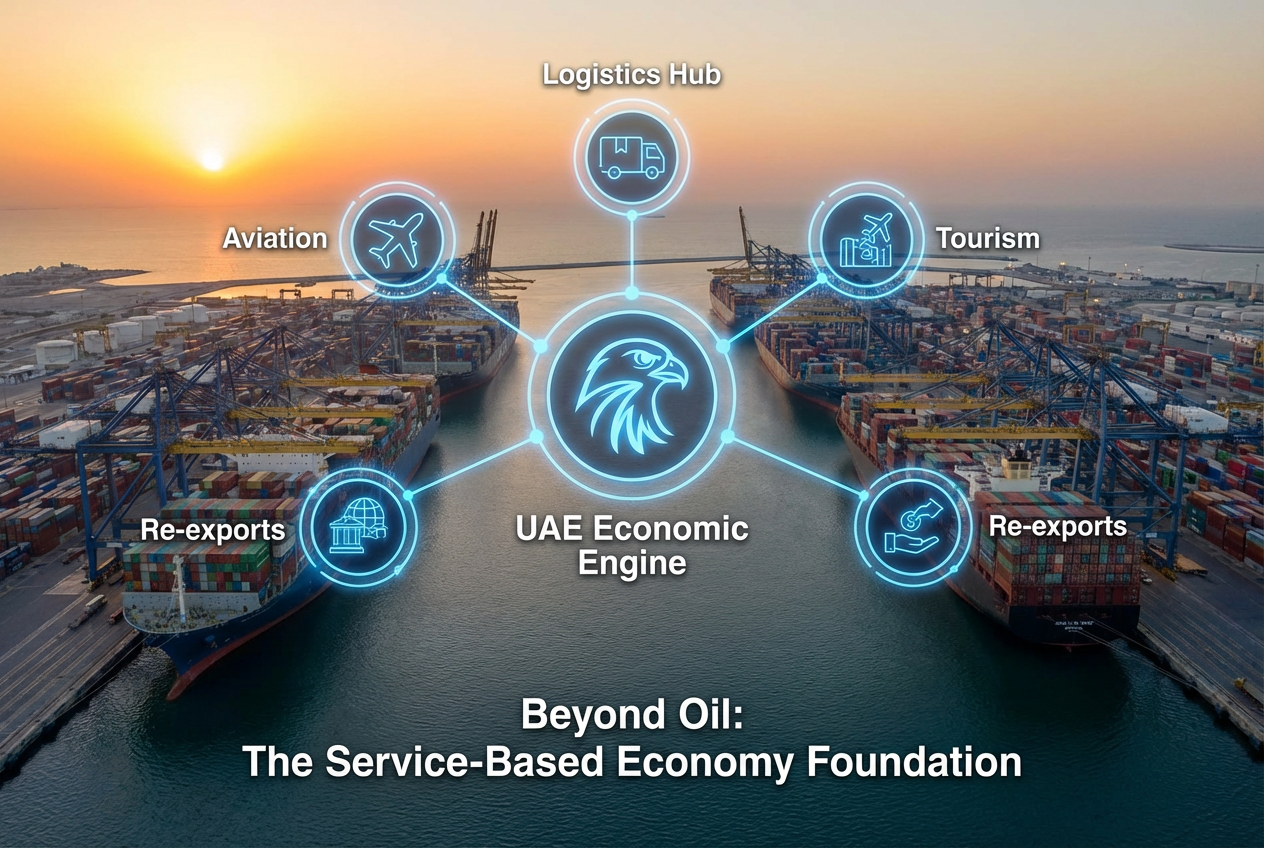 Infographic show UAE the mastermind behind the great game
The United Arab Emirates has long cultivated an image of glittering neutrality—a post-modern oasis of towering skyscrapers, luxury tourism, and frictionless global commerce. For decades, the narrative surrounding the federation, particularly its crown jewels of Abu Dhabi and Dubai, has been one of a simple, prosperous trading hub. Yet, beneath the glossy veneer of economic diversification and diplomatic agility lies a profoundly different reality. The UAE has evolved into a formidable, proactive "middle power," executing a highly assertive and frequently destabilizing grand strategy.
Far from being a mere participant in the shifting currents of global geopolitics, Abu Dhabi has emerged as a master orchestrator. By weaponizing its vast economic leverage—ranging from port infrastructure and illicit gold streams to digital assets and unprecedented defense pacts—the UAE is aggressively shaping geopolitical outcomes across the Middle East, Africa, and South Asia. This investigation will strip back the diplomatic pleasantries to examine the allegations that the UAE operates as a revisionist force: systematically undermining Saudi Arabia’s regional primacy, covertly destabilizing Pakistan’s economic infrastructure to preserve Dubai’s maritime hegemony, and funding violent proxy forces across the Horn of Africa.
Against the contemporary backdrop of the devastating US-Israel-Iran war and the bloody Pakistan-Afghanistan "open war" unfolding in early 2026, the UAE’s intricate web of influence is facing its ultimate stress test. We will track the hidden hands fueling these conflicts, revealing how the architects of the new Great Game are now navigating the infernos they helped ignite.
I: The UAE's Economic Pillars: The Foundation of Influence
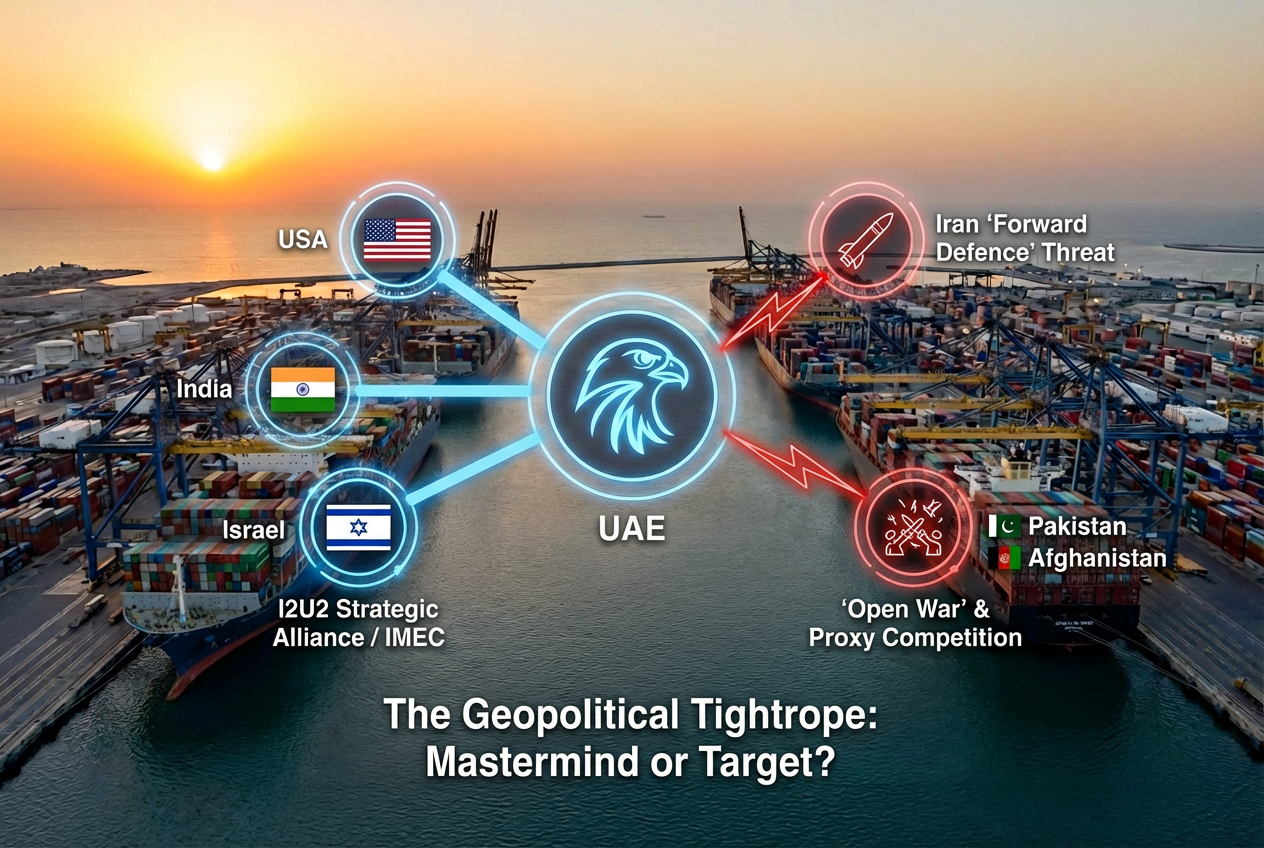 The infographic shows the UAE in an influential economic market
To understand the UAE’s geostrategic reach, one must first dismantle the mechanics of its modern economic engine. The era in which the Emirates relied solely on the subterranean lottery of crude oil has passed. Recognizing the finite nature of hydrocarbons, Abu Dhabi and Dubai pioneered a rapid shift toward a hyper-connected, service-based economy. Today, the nation’s lifeblood is pumped through logistics and transportation (anchored by its dominant aviation sector and seaports), a booming tourism and real estate market, sophisticated financial services, and an unparalleled re-export industry.
At the epicenter of this economic model sits Dubai’s Port Jebel Ali—the undisputed shipping giant of the Middle East. Jebel Ali is not merely a port; it is the beating heart of the UAE’s grand strategy. The city-state’s entire revenue model depends on serving as the indispensable, frictionless middleman for the trillions of dollars of trade flowing into and out of the Persian Gulf. To maintain this status, the UAE cannot simply compete; it must possess an absolute monopoly over regional logistics.
Consequently, the UAE has cultivated a unique "Middle Power" toolbox. Institutions that appear to be purely corporate—such as the sovereign wealth funds Mubadala and the Abu Dhabi Investment Authority (ADIA), the logistics behemoth DP World, and state-backed carriers like Emirates and Etihad—serve as direct instruments of state policy. Abu Dhabi deploys these entities strategically to buy influence, control critical infrastructure, and embed itself deeply into the political economies of weak, developing, or fragile states. For the UAE, a port concession in the Horn of Africa or an aviation bailout in South Asia is rarely just a business transaction; it is a strategic beachhead designed to project power far beyond the Arabian Peninsula.
II: The "Silent Economic War": Gwadar vs. Dubai and the Balochistan Connection
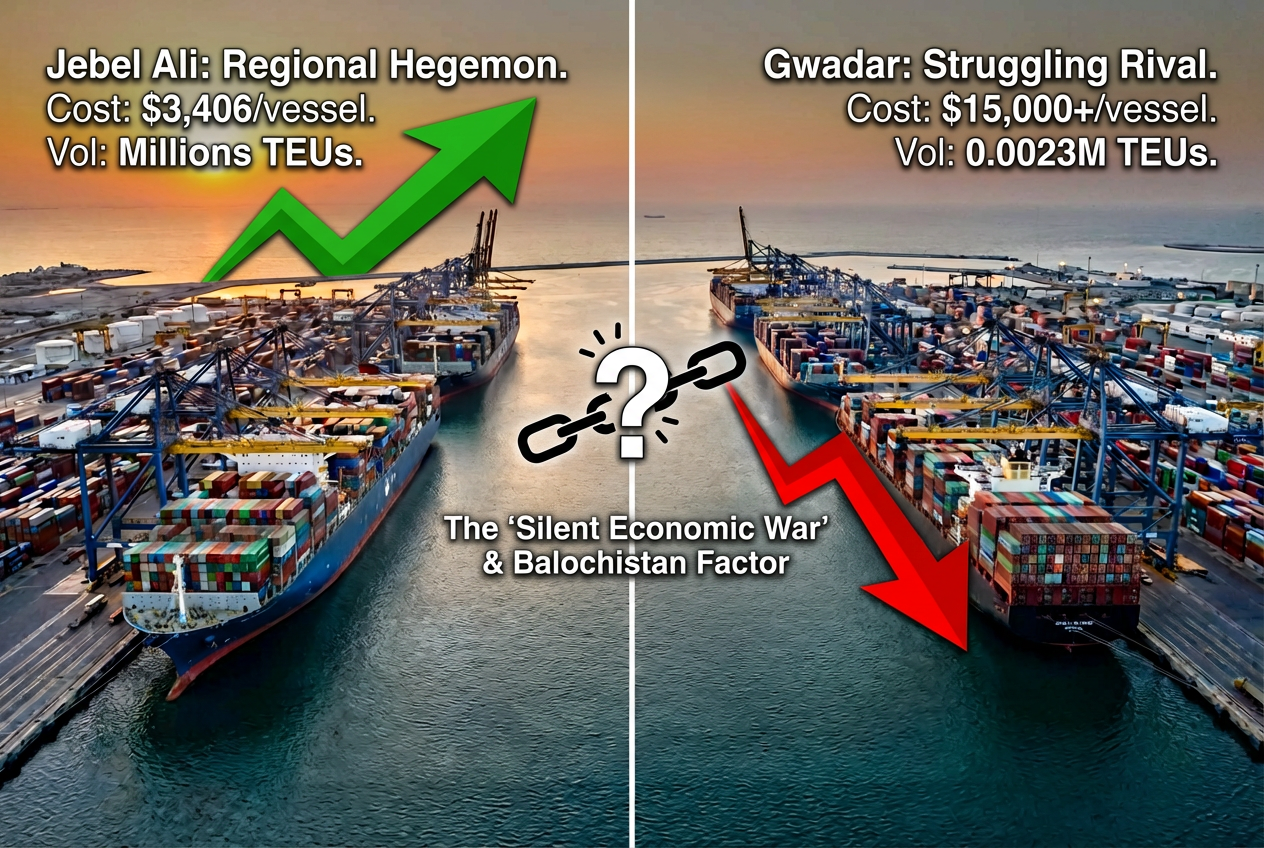 Comparision between Gwadar Vs Jebel ali ports
If Port Jebel Ali is the engine of the UAE’s prosperity, then the Pakistani Port of Gwadar represents an existential threat to that very model. Situated on the Arabian Sea, Gwadar is the crown jewel and deep-water terminus of the multi-billion-dollar China-Pakistan Economic Corridor (CPEC). By offering China, Central Asia, and Russia a direct, overland trade route to the open ocean, Gwadar physically bypasses the Persian Gulf and the heavily congested Strait of Hormuz. If fully realized, Gwadar would fundamentally decentralize maritime trade, stripping Dubai of its indispensable status.
Consequently, a "silent economic war" has been waged against Pakistan’s maritime ambitions. The stark contrast in performance metrics between the two regions is chillingly quantifiable. According to a damning 2025 global maritime report, a standard 50,000 GRT cargo vessel pays an exorbitant $18,900 at the Port of Karachi and $15,000 at Gwadar. In stark contrast, the same vessel pays just $3,406 at Jebel Ali. This crushing pricing structure, compounded by bureaucratic paralysis and deep-rooted inefficiencies, has effectively suffocated Gwadar. Recent data shows Gwadar handling a negligible 0.0023 million TEUs (Twenty-Foot Equivalent Units)—a microscopic fraction of Jebel Ali’s tens of millions.
The core question for geopolitical investigators is this: Is Gwadar's catastrophic underperformance merely the result of legendary Pakistani mismanagement, or has there been a concerted, external campaign to ensure it fails?
Intelligence analysts and regional experts increasingly point to the latter, highlighting a coordinated effort to undermine investor confidence in Pakistan's coastal infrastructure fundamentally. This brings us to the critical investigative angle: the alleged connection between the UAE’s covert apparatus and insurgent violence in Pakistan's Balochistan province.
Mounting reports suggest that foreign funding has systematically flowed to Baloch insurgent groups, most notably the Baloch Liberation Army (BLA), whose primary objective has been to attack Chinese nationals and sabotage CPEC infrastructure. The mechanism of this alleged funding is highly sophisticated, eschewing traditional, traceable banking networks. Investigations have pointed toward the exploitation of seemingly legitimate fronts based in the UAE—including unregulated e-gaming platforms, micro-transaction laundering, and decentralized digital assets (cryptocurrencies)—to funnel untraceable capital to insurgents. These financial lifelines ensure the BLA can maintain a steady tempo of violence, effectively scaring off foreign direct investment and skyrocketing the insurance premiums for any shipping company daring to dock at Gwadar.
The geostrategic motive is ruthlessly clear. Connect the dots: a perpetually destabilized Balochistan and a functionally "dismantled" Gwadar Port serve a dual, synergistic purpose. It permanently cripples Pakistan’s economic future while forcefully neutralizing the only viable, long-term geographic rival to Dubai’s status as the region’s premier trade and logistics hegemon. By allegedly stoking the fires of ethno-nationalist insurgency next door, the UAE preserves the peace and profitability of its own harbors.
III: The African Theatre: Dollars, Weapons, and the Saudi Proxy War
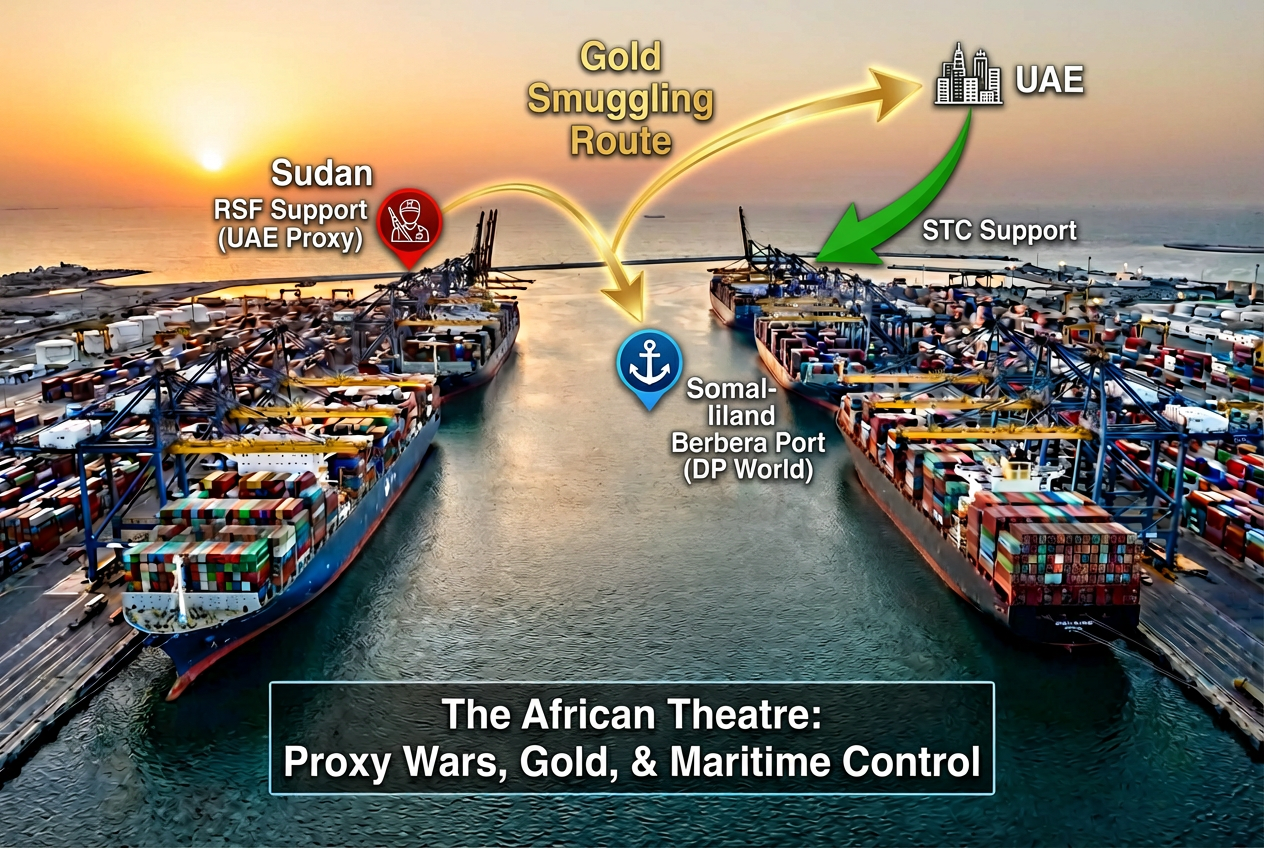 Infographics of Proxy wars by the UAE in the state of economics
While South Asia experiences the UAE's economic sabotage, the Horn of Africa and the Red Sea basin are bleeding from its direct military interventions. To understand this theatre, one must reframe the conflicts erupting across the region. The bloodshed in the Horn is not merely a collection of localized civil wars or humanitarian crises; it is the violent arena for a bitter, high-stakes proxy rivalry between the UAE and its nominal ally, Saudi Arabia.
In its quest to outmaneuver Riyadh, the UAE has forged what regional analysts term the "Axis of Secessionists." Instead of engaging in the arduous task of supporting central, internationally recognized governments, Abu Dhabi has found that aligning with malleable sub-state actors, warlords, and secessionist movements yields faster, cheaper geopolitical dividends. This strategy is vividly apparent in their deep financial and infrastructural ties with the unrecognized Republic of Somaliland (anchored by DP World’s Berbera port deal), their quiet presence in autonomous Puntland, and their long-standing military alliance with the rogue commander Khalifa Haftar in divided Libya.
The most catastrophic evidence of this destabilization strategy is currently playing out in the blood-soaked plains of Sudan. The UAE stands widely accused of providing extensive, clandestine military and financial support to the Rapid Support Forces (RSF), the paramilitary group locked in a genocidal civil war against the Sudanese Armed Forces (SAF). This backing is not a humanitarian oversight; it is a calculated, cold-blooded maneuver. The RSF controls the lucrative Jebel Amer gold mines. By backing the militia, the UAE secures billions in smuggled gold to feed Dubai's bullion markets while simultaneously securing a loyal proxy on the strategic Red Sea coast—a proxy that answers exclusively to Abu Dhabi, actively defying the diplomatic frameworks of Riyadh or Khartoum.
The evidence of this intervention has moved beyond rumor into the halls of international diplomacy. In late 2025 and early 2026, the official government of Sudan formally requested an emergency United Nations Security Council meeting concerning what it explicitly labeled UAE "aggression," presenting dossiers detailing Abu Dhabi’s continuous supply of heavy weapons and logistical equipment to the RSF. In Washington, US Secretary of State Marco Rubio publicly called for immediate international action to cut off these specific weapons supply chains to the RSF following a horrific string of mass atrocities. While a UN-backed probe is currently underway, critics and human rights organizations rightly note that its narrow mandate conveniently fails to investigate state sponsors, giving Abu Dhabi a diplomatic shield.
This overt maneuvering has triggered a fierce reaction from Saudi Arabia. Recognizing the UAE’s actions in Sudan—combined with its ongoing backing of the separatist Southern Transitional Council (STC) in Yemen—as a direct threat to Saudi hegemony, Riyadh has been pushed into a de-facto geopolitical alliance with Egypt. Both powers are now heavily supporting the SAF in Sudan, transforming a domestic power struggle into a full-blown regional proxy conflict.
Furthermore, the UAE’s strategic chess moves extend to Somalia. By functionally granting diplomatic recognition to Somaliland through bilateral agreements, the UAE engineered a total rupture in relations with the Federal Government of Somalia in Mogadishu. This deliberate fragmentation serves the broader UAE goal of dividing and conquering the littoral states to control the vital maritime chokepoints of the Red Sea and the Gulf of Aden. By doing so, Abu Dhabi holds a sword over the maritime security and economic lifelines upon which both Saudi Arabia’s "Vision 2030" and Egypt’s Suez Canal revenues depend.
Part IV: The Great Power Bbalancing Act: India, USA, Israel, and the I2U2 Axis
To shield its aggressive regional maneuvers from international blowback, the UAE has masterfully woven a web of indispensable alliances with major global powers. Foremost among these is the dramatic paradigm shift in UAE-India relations—a strategic hedge of monumental proportions.
Historically bound by Islamic solidarity with Pakistan, the UAE has radically pivoted toward New Delhi, driven by pure economic pragmatism and shared threat perceptions. This shift was cemented by the landmark Comprehensive Economic Partnership Agreement (CEPA) and culminated in the January 2026 Strategic Defence Partnership Framework Agreement, which integrates the two nations' military industrial complexes and naval intelligence sharing.
For Islamabad, this represents a devastating dilemma. The UAE's deepening military and economic embrace of India signals a hostile realignment. Abu Dhabi has notably refused to condemn the Indian government's controversial actions in Kashmir, nor has it entertained Pakistan's protests regarding alleged Indian intelligence operations in Balochistan. Instead, the UAE has decisively chosen to "look East" to secure its economic future and strategic depth. Furthermore, the UAE utilizes the "bystander effect" to perfection. By remaining silent and stepping back, Abu Dhabi facilitates an environment where Pakistan’s internal security and economic challenges are compounded by Indian pressure. This deliberate inaction further erodes the viability of CPEC, inadvertently achieving the UAE’s goal of keeping Gwadar weak without firing a single official shot.
This bilateral pivot is part of a larger, more ambitious architecture: the Quadrilateral Alliance, formalized as the I2U2 grouping (India, Israel, UAE, USA). Often sanitized in diplomatic press releases as an economic and technological forum, I2U2 is, in reality, a potent strategic bloc. It was fundamentally designed by Washington and New Delhi—with eager participation from Tel Aviv and Abu Dhabi—to counter the expanding footprint of Chinese influence (specifically CPEC and the Belt and Road Initiative) and to contain Iranian power across the Middle East.
The physical manifestation of this alliance is the India-Middle East-Europe Economic Corridor (IMEC). Designed to move goods from India, through UAE ports, across the Arabian Peninsula via rail, into Israel, and finally to Europe, IMEC is a direct, undeniable competitor to China's BRI.
However, there is a "harmful collaboration thesis" at play here. While IMEC and I2U2 are framed in the language of positive, peaceful connectivity, they possess a much darker, exclusionary side. This architecture is explicitly designed to geographically and economically isolate regional rivals—namely, Iran and Pakistan. By creating an alternative trade, energy, and security architecture that purposefully excludes them, the UAE and its partners are functionally drawing new, hard lines of conflict in the sand, cornering desperate nations and guaranteeing future instability.
Part V: Controversies & Current Conflicts: The Mastermind Tested
As of early 2026, the UAE’s intricate, multifaceted strategy of being everything to everyone has violently collided with reality. The mastermind is now facing the blowback of the very regional architectures it helped construct.
The Iran-US-Israel War: The UAE's Tightrope Walk
The most terrifying development for Abu Dhabi has been its entanglement in the horrific, cascading US-Israel-Iran war. The UAE now finds itself directly in the crosshairs of a conflict it desperately wished to avoid. As part of Iran's "forward defence" strategy—a doctrine designed to drag the entire Persian Gulf into chaos to deter American or Israeli strikes on its homeland—Tehran and its proxies have launched ballistic missiles and suicide drones directly at the UAE.
Iran knows precisely where the UAE’s vulnerabilities lie. The Emirates hosts critical American military infrastructure, most notably the Al Dhafra Air Base and the vital US Navy logistics hub at Jebel Ali. The UAE is caught in an existential Catch-22. Having boldly normalized ties with Israel via the Abraham Accords and acting as a premier US defense partner, it is a legitimate strategic target in the eyes of the IRGC. Yet, Abu Dhabi cannot afford to be seen as an active belligerent against Iran without risking the total annihilation of its economic crown jewels. The recent, unprecedented closure of Dubai International Airport—the world's busiest international transit hub—due to airspace threats during the conflict served as a stark, terrifying reminder of the nation’s supreme vulnerability.
Can the UAE's carefully constructed neutrality survive being physically struck in a war between its patron (the US and Israel) and its menacing neighbor (Iran)? Is its strategy of being everyone's friend now making it everyone's target?
The Pakistan-Afghanistan "Open War": The Spoilers and Bystanders
Simultaneously, the UAE’s proxy maneuvering is being tested on a second front. Hostilities between Pakistan and the Taliban government in Afghanistan have catastrophically escalated into what Pakistan's Defense Minister has officially termed an "open war." The collapse of a fragile, Qatar-brokered security agreement has resulted in devastating cross-border airstrikes hitting Kabul and Kandahar, while Afghan forces and allied militants have launched audacious strikes deep into Pakistani territory, reaching the outskirts of Islamabad.
While the violence is visceral, the true war is being fought by hidden hands behind the scenes. Pakistan has aggressively accused the usual suspects—namely India—of deepening ties with the Taliban to systematically pressure Islamabad on two active fronts. However, a startling admission from Islamabad has revealed the true nature of the new Great Game. Pakistan's Defense Minister recently made a blunt, unprecedented confession that Islamabad has totally lost its historical influence over Afghanistan to far wealthier regional states. Naming the UAE, Qatar, Turkey, Saudi Arabia, and China, he stated grimly: "They can spend money, and we cannot."
How does the UAE fit into this bloody equation? As the traditional power broker (Pakistan) goes bankrupt and bleeds, the UAE has stepped into the vacuum, leveraging its massive sovereign wealth to buy influence in Kabul. By controlling mining concessions, managing Afghan airports, and engaging the Taliban diplomatically, the UAE has introduced a new layer of intense Gulf competition against its rival, Qatar. While Pakistan is consumed by an "open war" on its western border, its geoeconomic rivals in the Gulf are quietly consolidating influence, ensuring that any future Afghan trade is tethered to Jebel Ali, rather than Gwadar.
As Pakistan fights a desperate war on one border and watches its strategic deep-water port wither and die on another, which of these 'hidden hands' stands to gain the most from its total distraction?
Conclusion
The United Arab Emirates is vastly more than the simplistic economic success story promoted by global PR firms. Its meteoric rise as a Middle Eastern "mastermind" is the result of a ruthless, highly calculated grand strategy. Abu Dhabi has proven entirely willing to utilize its profound economic leverage to wage proxy wars, structurally undermine its geoeconomic competitors like Gwadar, encircle its Saudi allies, and construct powerful international blocs that isolate its adversaries. It is a state that thrives on the very edge of the sword, exploiting the fragility of others to fortify its own golden shores.
Yet, grand strategy rarely survives contact with total war. The events of 2026 have pushed the Emirati model to the brink. As Iranian missiles rain down on the outskirts of Dubai and the broader region descends into the chaos of "open wars" from the Hindu Kush to the Red Sea, a definitive reckoning has arrived. The UAE can no longer pull the strings of the Middle East from the safety of the shadows.
We are left to confront a vital, terrifying question: Is the United Arab Emirates truly a stabilizing middle power charting a course for regional prosperity, or is it a disruptive, revisionist state that is now facing the catastrophic blowback from the very fires it helped stoke?

You must be logged in to post a comment.