

1. Introduction
Artificial Intelligence, commonly known as AI, is one of the most exciting developments in modern technology. It is changing the way people live, work, study, communicate, and solve everyday problems. From smartphones and computers to healthcare and education, artificial intelligence has become an important part of our daily lives.
AI refers to computer systems that can perform tasks that normally require human intelligence. These tasks include understanding language, recognizing images, learning from information, and solving problems. As technology continues to develop, artificial intelligence is creating new opportunities for individuals, businesses, and communities around the world.
2. Artificial Intelligence in Everyday Life
Many people use artificial intelligence every day without even realizing it. When we search for information on Google, receive video recommendations on YouTube, or use voice assistants, AI often works behind these services.
Smartphones use artificial intelligence to improve photographs, recognize faces, organize information, and provide helpful suggestions. Online shopping platforms also use AI to recommend products based on customers' interests.
These features make everyday activities more convenient and save time. AI can help people find information quickly and complete certain tasks more efficiently. However, users should also understand how digital platforms collect and use their personal information.
3. The Role of AI in Education
Education is one of the most important fields where artificial intelligence is creating positive changes. Students can use AI-powered learning tools to understand difficult subjects, improve their language skills, and explore new ideas.
Some educational applications provide personalized learning experiences. They can help students practise mathematics, improve grammar, and understand complicated topics through simple explanations.
Teachers can also benefit from AI technology. It can help them prepare educational materials, organize lessons, and create interactive learning activities.
However, students should not depend entirely on artificial intelligence. Reading books, completing assignments independently, asking teachers questions, and developing critical thinking skills remain essential for successful learning.
4. Artificial Intelligence in Healthcare
Healthcare is another field where artificial intelligence is making a difference. Modern medical systems can use AI to analyze medical images, organize patient information, and support medical research.
Some AI-powered technologies help medical professionals identify patterns in medical information. Researchers are also exploring how artificial intelligence can support the development of medicines and improve healthcare services.
These developments may help hospitals work more efficiently and support better patient care.
However, artificial intelligence cannot replace qualified doctors. Medical decisions require professional knowledge, experience, and human judgment. AI should be considered a supportive tool rather than a replacement for medical professionals.
5. AI in Business and Employment
Artificial intelligence is changing the way businesses operate. Many companies use AI-powered systems to manage information, understand customer needs, and improve their services.
For example, customer support systems can answer common questions, while data analysis tools help businesses understand market trends. AI can also assist with organizing schedules, managing documents, and identifying areas where improvements are needed.
At the same time, automation may change some traditional jobs. Certain repetitive tasks can be performed by computer systems, which means workers may need to develop new skills.
Learning digital skills, communication, creativity, and problem-solving can help people prepare for future career opportunities.
6. Benefits of Artificial Intelligence
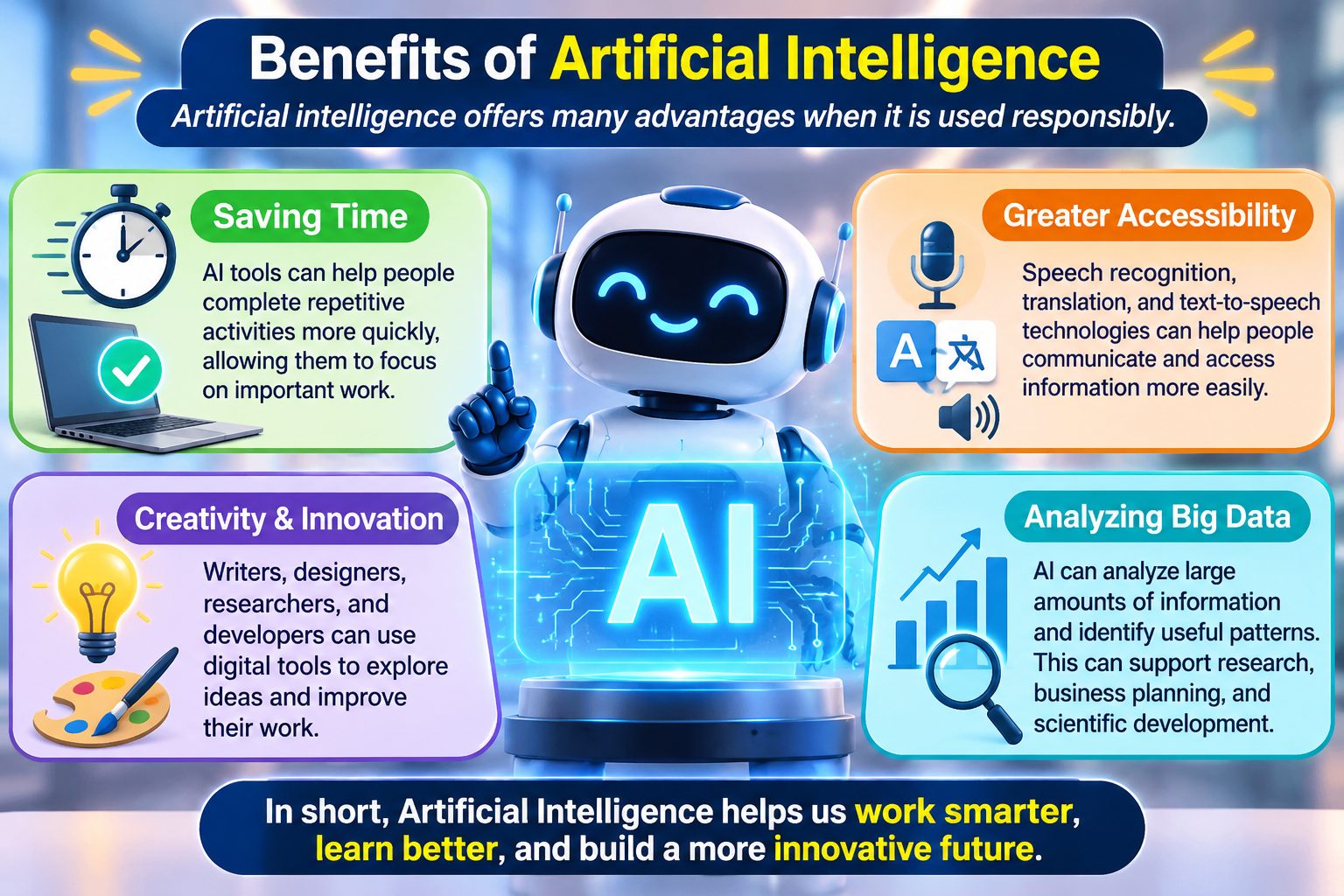
Artificial intelligence offers many advantages when it is used responsibly.
One major benefit is saving time. AI tools can help people complete repetitive activities more quickly, allowing them to focus on important work.
Another benefit is accessibility. Speech recognition, translation, and text-to-speech technologies can help people communicate and access information more easily.
AI also supports creativity and innovation. Writers, designers, researchers, and developers can use digital tools to explore ideas and improve their work.
In addition, artificial intelligence can analyze large amounts of information and identify useful patterns. This can support research, business planning, and scientific development.
7. Challenges and Risks of Artificial Intelligence
Although AI has many benefits, it also creates challenges that society needs to understand.
Privacy is one important concern. Some applications collect personal information, so users should carefully review privacy settings and avoid sharing sensitive details unnecessarily.
Another challenge is misinformation. Artificial intelligence can sometimes produce incorrect information or realistic-looking content that is misleading. People should always verify important facts through reliable sources.
Job changes are also a concern. As technology develops, some industries may require different skills and fewer workers for certain repetitive tasks.
Responsible development, digital education, and appropriate regulations can help reduce these risks.
8. The Future of Artificial Intelligence
The future of artificial intelligence offers many exciting possibilities. Researchers are developing new systems that may improve transportation, agriculture, education, healthcare, and scientific research.
Smart cities may use AI to manage traffic and improve energy efficiency. Educational technology may provide more personalized learning experiences, while healthcare research may discover better ways to support patients.
However, the future of AI will depend on how responsibly people develop and use this technology.
Human creativity, emotions, ethical thinking, and decision-making will continue to be important. Technology should support human abilities and help create better opportunities for everyone.
9. Why Learning About AI Is Important
Understanding artificial intelligence is becoming increasingly important in the modern world. Students and professionals should learn about digital technology because it is influencing many career fields.
People do not necessarily need to become computer programmers to benefit from AI. Learning how to use digital tools, check information, protect personal data, and solve problems can be useful for almost everyone.
Developing these skills can help individuals become more confident and prepared for future changes.
10. Conclusion
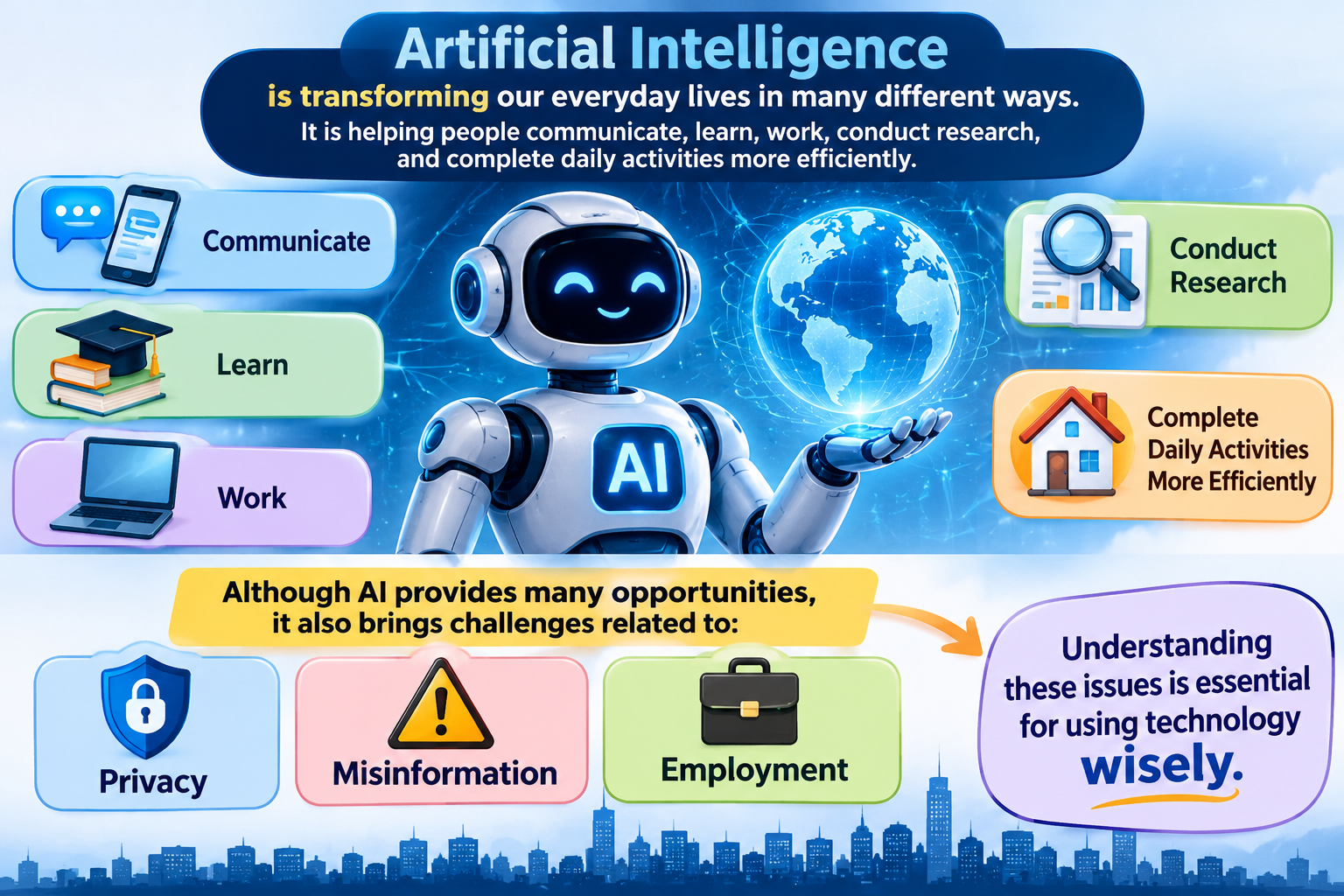
Artificial intelligence is transforming our everyday lives in many different ways. It is helping people communicate, learn, work, conduct research, and complete daily activities more efficiently.
Although AI provides many opportunities, it also brings challenges related to privacy, misinformation, and employment. Understanding these issues is essential for using technology wisely.
The most important thing is to remember that artificial intelligence is a tool created to support people. By learning new skills, staying informed, and using technology responsibly, we can benefit from its possibilities and build a smarter and more connected future.







Comments 0
Sign in to join the conversation.
No comments yet. Be the first to say something.