

Introduction
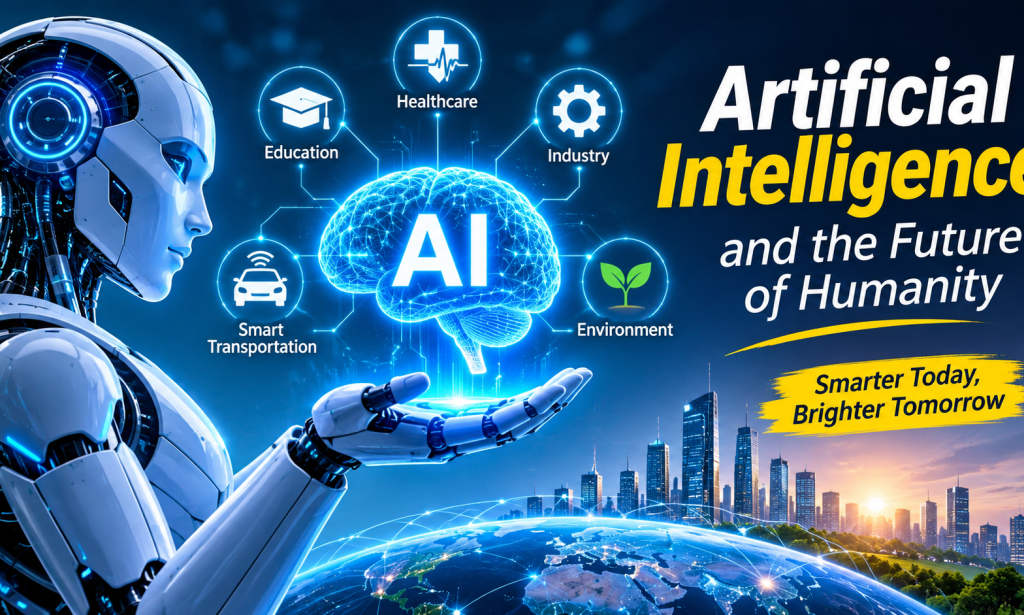
Artificial Intelligence (AI) is one of the most exciting scientific and technological developments of the modern world. From smartphones and online shopping to healthcare, education, and transportation, artificial intelligence is becoming an important part of everyday life. Technologies that once seemed like science fiction are now helping people solve problems, save time, and make better decisions.
But what exactly is artificial intelligence, how does it work, and how will it shape the future of humanity? Understanding AI is becoming increasingly important as this technology continues to transform different industries and the way people live and work.
What Is Artificial Intelligence?
Artificial Intelligence is a branch of computer science that focuses on developing machines and software capable of performing tasks that normally require human intelligence. These tasks include learning, understanding language, recognizing images, solving problems, and making predictions.
Unlike traditional computer programs that follow fixed instructions, many AI systems can learn patterns from large amounts of data. This ability allows them to improve their performance and handle increasingly complex tasks.
For example, when a streaming platform recommends movies based on your interests or a smartphone recognizes your face, artificial intelligence may be working behind the scenes.
Some popular branches of AI include:
Machine Learning: Allows computers to learn patterns from data and improve their performance.
Natural Language Processing: Helps machines understand and generate human language.
Computer Vision: Enables computers to interpret images and videos.
Deep Learning: Uses artificial neural networks to solve complex problems.
These technologies are making artificial intelligence useful in many areas of modern society.
How Artificial Intelligence Is Changing Everyday Life
AI is no longer limited to research laboratories or large technology companies. It is already being used in ordinary activities.
Smart assistants can answer questions, navigation applications can suggest routes, and recommendation systems can help users discover products, music, and movies.
AI-powered translation tools also make communication easier between people who speak different languages. Similarly, email services use intelligent systems to identify unwanted messages and organize information.
These examples demonstrate how artificial intelligence can simplify everyday tasks and improve convenience.
The Role of AI in Healthcare
Healthcare is one of the most promising areas for artificial intelligence. Medical professionals and researchers are exploring AI systems that can help analyze medical images, organize patient information, and identify patterns in health data.

For example, AI-assisted imaging systems can help trained specialists examine X-rays, MRI scans, and other medical images. These technologies may support the early identification of certain health conditions.
Artificial intelligence can also help researchers analyze scientific information and investigate potential treatments.
However, AI should not replace qualified doctors or medical professionals. Medical decisions require human judgment, professional knowledge, and an understanding of individual patients. Protecting patient information and checking the reliability of AI systems are also essential.
How AI Is Transforming Education
Education is another field experiencing significant changes because of artificial intelligence.
AI-powered learning tools can explain difficult concepts, provide practice exercises, and help students understand subjects at their own pace. Teachers can also use these technologies to prepare educational materials and organize learning activities.
For example, a student struggling with mathematics can use an AI learning tool to receive a step-by-step explanation of a concept. Similarly, language-learning applications can provide feedback on vocabulary and grammar.
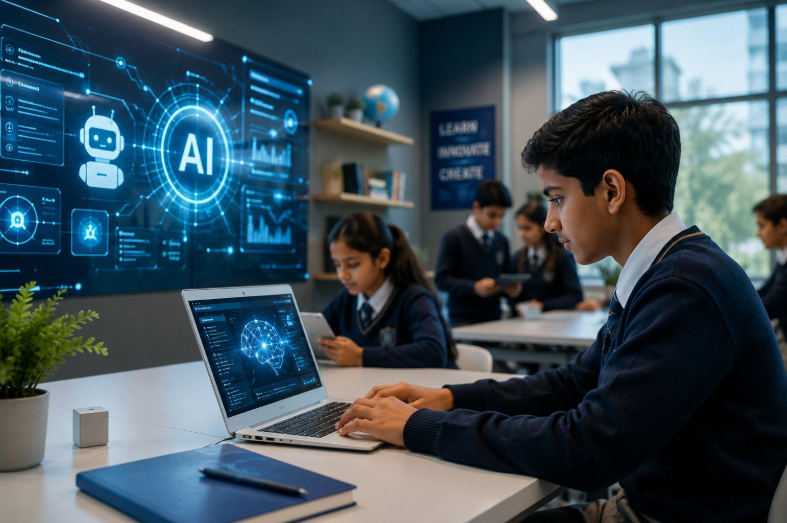
Despite these benefits, students should not depend entirely on AI-generated answers. Independent thinking, creativity, research skills, and communication remain essential parts of education.
The best approach is to use artificial intelligence as a learning assistant rather than a replacement for genuine learning.
Artificial Intelligence and the Future of Jobs
One of the biggest questions surrounding artificial intelligence is its impact on employment.
AI can automate repetitive tasks, analyze information, and assist with activities that previously required considerable human effort. Businesses are already exploring these capabilities to improve productivity and reduce operational difficulties.
Some jobs may change significantly as automation becomes more common. At the same time, new opportunities are emerging in areas such as AI development, data science, robotics, cybersecurity, and technology management.

This means that future workers will need to develop new skills and adapt to technological changes.
Critical thinking, creativity, problem-solving, communication, and digital literacy will remain valuable skills in an increasingly automated world.
The Challenges and Risks of Artificial Intelligence
Although AI offers many opportunities, it also creates important challenges.
One major concern is privacy. AI systems often depend on large amounts of information, and the misuse or unauthorized collection of personal data can create serious problems.
Another concern is inaccurate information. AI-generated content can sometimes contain incorrect facts or misleading explanations. Therefore, important information should always be checked against reliable sources.
Bias is another issue. If an AI system is trained using incomplete or unfair data, its results may also become biased.
There are also concerns about employment changes, misinformation, cybersecurity, and the concentration of technological power.
Addressing these challenges requires responsible development, appropriate regulations, transparency, and human oversight.
What Does the Future of Artificial Intelligence Look Like?
The future of artificial intelligence is likely to involve deeper integration with science, healthcare, education, manufacturing, and environmental research.
Scientists are exploring how AI can help analyze complex scientific data, improve research methods, and accelerate discoveries. In environmental science, AI tools can support weather forecasting, energy management, and the monitoring of environmental changes.
Robotics is another area where AI may create significant developments. Intelligent machines could assist with complex industrial processes, scientific experiments, and certain tasks in dangerous or difficult environments.
However, technological progress must be guided by human values. The goal should not simply be to develop more powerful machines but to create technologies that improve people's lives safely and fairly.
Conclusion
Artificial Intelligence is transforming the modern world and opening new possibilities for science, business, education, and healthcare. Its ability to process information, recognize patterns, and support complex tasks makes it one of the most influential technologies of our time.
However, its success will depend on how responsibly people develop and use it. Privacy, accuracy, fairness, education, and human decision-making must remain important priorities.
Artificial intelligence should be viewed as a powerful tool that supports human abilities rather than completely replacing human intelligence. By understanding its opportunities and limitations, society can use this technology to build a more innovative, productive, and sustainable future.








Comments 0
Sign in to join the conversation.
No comments yet. Be the first to say something.