

Anxiety is not a thought problem with a thought solution. It is a body state that produces thoughts, and the body responds to daily routine far more reliably than it responds to reasoning. You cannot argue your way out of a racing heart at 2am. You can, however, lower the baseline so it happens less often and recovers faster.
Everything below is something you do on a normal day, not in a crisis. The crisis tools are different and less useful if the baseline is not being managed.
What Actually Helps
Anxiety is maintained by three things: poor sleep, uncontrolled physiological arousal, and avoidance. Anything that improves sleep, teaches the nervous system to come down from arousal, or shrinks the avoidance gets traction. Anything that just distracts you resets the clock without changing it.
That is the filter to apply to every habit on this list, and to anything else you read about.
The Top 10 Habits
1. Slow Breathing Before You Need It
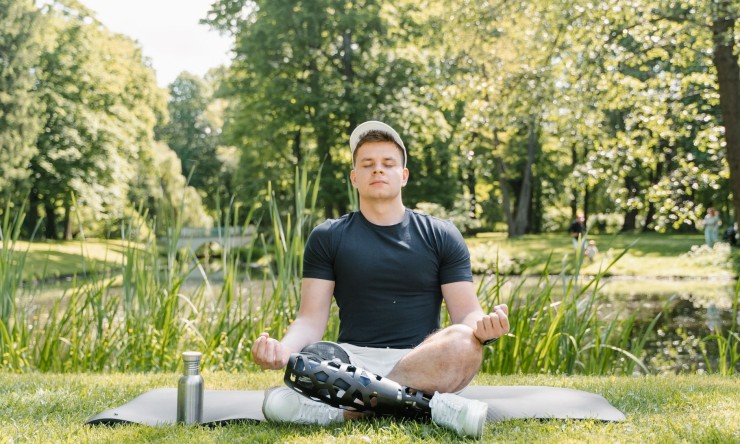
Five minutes daily of breathing with a longer exhale than inhale. Twice as long out as in. This is the fastest physiological lever available because it directly raises vagal tone.
Practising only during panic is like training on match day.
2. Consistent Wake Time
Same wake time daily, including weekends. Sleep regularity predicts anxiety far better than total sleep duration, and the effect is visible within a week.
Set the wake time first. Bedtime follows on its own.
3. Morning Daylight
Ten minutes outdoors within an hour of waking. Light sets circadian timing, and stable circadian timing is one of the strongest protections against the 3am spiral.
Cloud cover still works. Indoor lighting does not.
4. Movement, Not Training
A thirty-minute walk most days reduces anxiety scores measurably. It does not need to be a workout, and the effect is not about fitness.
Walk without a podcast for part of it, at least twice a week.
5. Limit Caffeine After Noon
Caffeine has a six-hour half-life. A 3pm coffee is still meaningfully active at bedtime, and its effect on anxiety is dose-dependent and invisible because you never feel it as "caffeine".
Cut it and give yourself ten days before judging.
6. Keep a Worry Window
Twenty minutes, at a set time, to write down worries and what you can do next. Outside that window, worries are written into a list rather than pursued immediately.
This is the most effective habit on the list for chronic background worrying.
7. Reduce Alcohol
Alcohol reduces anxiety for two hours and raises it for fourteen. If you are using it to sleep, you are trading one night for a worse week.
Track two weeks of drinking against two weeks of morning anxiety before deciding.
8. One Small Avoidance, Daily
Do one slightly uncomfortable thing you would normally dodge. Anxiety shrinks through approach, not through safety. Very small and repeated beats large and rare.
The size does not matter. The repetition does.
9. Signal Safety to the Body
Warm shower, cold hands, a heavy blanket, or a hand on your chest — anything that gives the nervous system a concrete, physical signal of safety.
These are not gimmicks; they are physiology that happens to be pleasant.
10. Talk to One Person Daily
A real conversation, not a group chat, not scrolling. Isolation and anxiety feed each other, and the daily contact habit interrupts the loop before it builds.
Three minutes on the phone counts.
How to Start Without Overwhelming Yourself
Choose breathing and wake time. Those two in the first two weeks. Breathing gives you something to use immediately, and fixating the wake time produces results within about a week that shows up without effort.
Add movement in week three, the worry window in week four. Anything faster will not hold.
When to Get Help
Habits manage baseline. They are not a treatment for anxiety that stops you working, sleeping, or leaving the house, and they are not a substitute for professional support.
WHO's overview of anxiety disorders is a clear starting point, and NIMH's anxiety resources explain treatment options in plain language. If symptoms persist for more than a few weeks, see a professional.
What Makes Anxiety Worse, Quietly
Skipping meals and running on caffeine and sugar produces a physiological state almost identical to anxiety: raised heart rate, shakiness, irritability. Many people are treating low blood sugar as a mental health crisis every afternoon.
Doom-scrolling before sleep is another one. It combines bright light, information threat, and a passive posture exactly when the nervous system needs the opposite. It is not moral weakness, it is a direct input to the system you are trying to calm.
Reassurance-seeking feels like relief and works like fuel. Every time you check that a worry is unfounded, you teach your brain that the worry was worth checking. The relief lasts minutes; the habit lasts months.
Finally, unstructured idle time is not automatically rest. For an anxious mind, an empty hour often becomes a thinking hour. Give open time a shape, even a loose one.
Building a Short Routine That Fits a Real Day
Six minutes in the morning: two minutes of slow breathing, two minutes of daylight, two minutes of naming what today actually requires. That is the whole daily floor, and it is small enough to survive a bad night.
At night, the only habit that matters is a consistent wind-down. Dim the lights an hour before bed, put the phone on a charger in another room, and write tomorrow's three tasks so your mind does not need to keep reminding you.
When anxiety spikes anyway, do not try to think your way down. Move first: a walk, cold water on your wrists, ten slow squats. Change the body state, then address the content. Reasoning with a nervous system in alarm is not reasoning at all.
Keep a short list of what helped last time. Anxiety makes you forget that anything ever worked, and a written record is the only argument that survives the moment.
The Bottom Line
Anxiety responds to routine, sleep, movement, and approach far more than to insight. Change the baseline in the body first; the thoughts follow the body far more willingly than the body follows the thoughts.





Comments 0
Sign in to join the conversation.
No comments yet. Be the first to say something.