

The Deliverance of Willow: The Cricket Matches That Changed History Forever
When C.L.R. James penned his immortal query in Beyond a Boundary—“What do they know of cricket who only cricket know?”—he articulated a reality that extends far beyond the boundary ropes. Cricket is never merely a sport; it is a mirror reflecting empire, geopolitical drama, racial emancipation, and societal transformation. In its long history, thousands of matches have been played, but a select few shattered the quiet rhythms of the game, altering the trajectory of world history, international relations, and global culture.
Here is the story of the iconic cricket matches that redefined history forever.
1. The Birth of a Rivalry: England vs. Australia (The Oval, 1882)
The Dawn of "The Ashes"
On a rain-drenched August afternoon at The Oval in South London, 11 men from Australia did the unthinkable: they defeated England on English soil for the first time in a Test match. Set a modest target of 85 runs, the English batting lineup crumbled under the lethal pace and pressure of Fred Spofforth, the "Demon Bowler," falling just seven runs short.
The immediate aftermath shocked Victorian England. A sporting defeat was felt as a blow to Imperial prestige. Days later, The Sporting Times published a famous mock obituary:
"In Affectionate Remembrance of ENGLISH CRICKET, which died at the Oval... The body will be cremated and the ashes taken to Australia."
Why It Changed History
This single defeat birthed The Ashes, sports' oldest and most intense international rivalry. Beyond the trophy, this match fundamentally altered the dynamic between the imperial center (Britain) and its colonies (Australia). It signaled that the dominance of the British Empire was no longer unquestioned and helped foster a nascent Australian national identity—giving the nation a sense of confidence that carried into its federation in 1901.
2. The Empire’s Darkest Hour: The Bodyline Series (Adelaide, 1933)
Ruthless Tactics at Adelaide Oval
By the early 1930s, Sir Donald Bradman was dismantling English bowling with superhuman consistency. To curb his genius and reclaim the Ashes during their 1932–33 tour of Australia, English captain Douglas Jardine implemented a terrifying tactical innovation known as "Fast Leg Theory"—popularly dubbed Bodyline.
Jardine instructed his fastest bowlers, Harold Larwood and Bill Voce, to aim short-pitched deliveries directly at the batsmen’s bodies, surrounding them with a dense leg-side field set to catch deflection off their bats or bodies. During the Third Test at the Adelaide Oval, Australian captain Bill Woodfull was struck over the heart, and wicketkeeper Bert Oldfield suffered a fractured skull.
The Diplomatic Crisis
The crowd surged toward a riot, and the Australian Board sent a frantic cable to the Marylebone Cricket Club (MCC):
"Bodyline bowling has assumed such proportions as to threaten the best interests of the game... In our opinion, it is unsportsmanlike, un-Australian, foul, and unfair."
The British response was stern, threatening to cancel the tour and sever diplomatic and trade ties. At a time when both nations were reeling from the Great Depression, the British cabinet expressed fear that the dispute could jeopardize imperial trade agreements.
Historical Impact
Bodyline pushed cricket to the edge of a diplomatic breakdown. It exposed the ruthlessness of imperial power dynamics and forced the MCC to rewrite the rules of the sport, banning short-pitched tactical targeting. It remains the most politically explosive cricket series ever played.
3. Breaking the Chains: West Indies vs. England (Lord's, 1950)
The First Victory on Imperial Ground
In 1950, a West Indian side featuring two young, gifted spinners—Sonny Ramadhin and Alf Valentine—arrived in London. Cricket in the Caribbean was deeply divided along racial lines: white elites held leadership, while Black and Indo-Caribbean players made up the ranks.
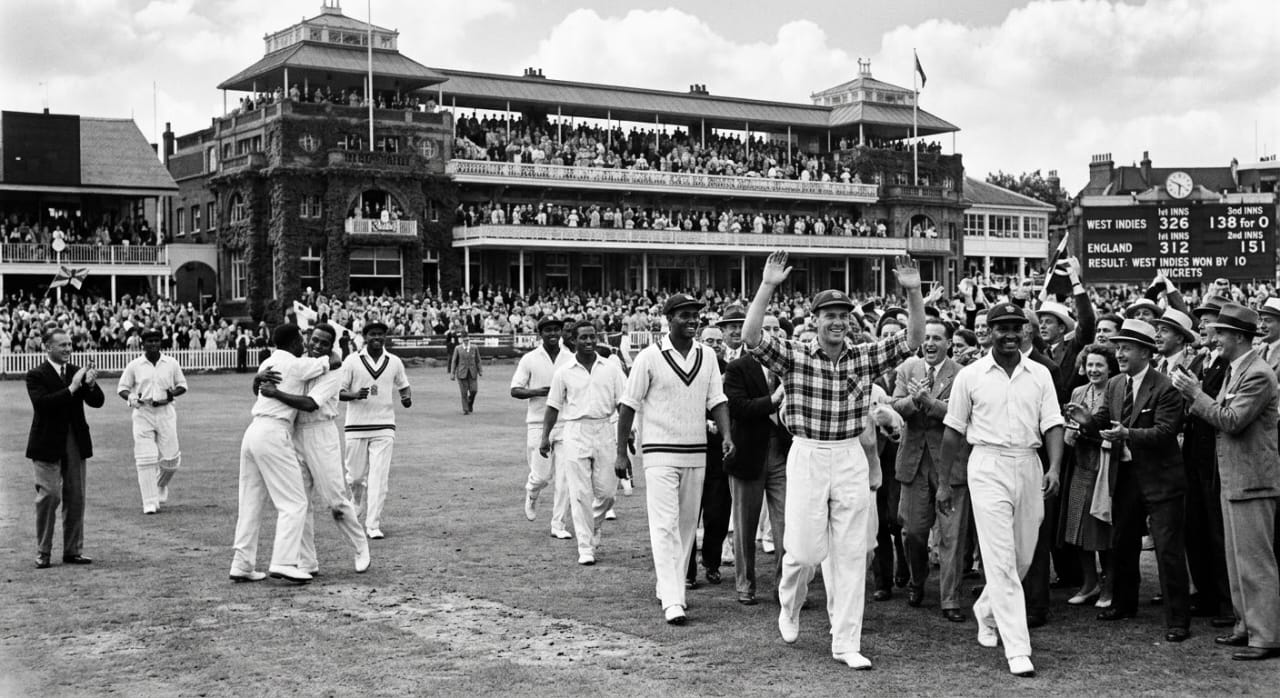
At the "Mecca of Cricket," Lord's, the West Indies recorded their first-ever Test victory on English soil, routing England by 326 runs.
The Cultural Explosion
As the final English wicket fell, hundreds of West Indian immigrants from the Empire Windrush generation invaded the pitch. Calypsonian Lord Beginner immortalized the moment in song:
"With those two little pals of mine / Ramadhin and Valentine!"
Why It Changed History
This match served as a profound catalyst for post-colonial pride. It demonstrated that Caribbean men could meet their colonial masters on their own turf, under their own rules, and defeat them convincingly. It accelerated the political independence movements across the West Indian nations through the 1950s and 1960s and laid the groundwork for Frank Worrell to become the team's first permanent Black captain a decade later.
4. Cricket as Diplomacy: Pakistan vs. India (Bangalore, 1987)
The High-Stakes Border Tension
In early 1987, military mobilization along the Line of Control had brought India and Pakistan to the brink of war. Operation Brasstacks had heightened troop deployments, and fears of military escalation were widespread across South Asia.
Amid this crisis, Pakistan was on a full Test tour of India. Recognizing the immense tension, President General Zia-ul-Haq engaged in what became famous as "Cricket Diplomacy." Unannounced, General Zia flew to India to watch the Fifth Test match in Bangalore alongside Indian Prime Minister Rajiv Gandhi.
The Match and Its Legacy
On a spinning dust-bowl at Bangalore, Pakistan snatched a historic 16-run victory, anchored by a masterclass 96 from Sunil Gavaskar on a treacherous pitch and lethal bowling from Iqbal Qasim and Tauseef Ahmed.
More important than the result was the political outcome. Sitting side-by-side at the stadium, the two leaders held informal talks that diffuse military tensions. Troop withdrawals were negotiated shortly after. It proved that cricket could act as a bridge across geopolitical fault lines when formal diplomacy failed.
5. The Rebel Tour and Re-Emergence: South Africa vs. India (Calcutta, 1991)
Eden Gardens Welcomes the Proteas
For over two decades, South Africa had been isolated from international sport due to its abhorrent policy of Apartheid. However, following the release of Nelson Mandela in 1990 and steps toward dismantling racial segregation, the International Cricket Council (ICC) lifted South Africa's ban.
On November 10, 1991, South Africa stepped onto the pitch for an ODI at Eden Gardens in Calcutta before a roaring crowd of over 100,000 spectators
+-------------------------------------------------------------------+
| THE EVOLUTION OF CRICKET DIPLOMACY |
+-------------------------------------------------------------------+
| 1933: Bodyline Series --> Threat of Imperial & Trade Breakdown |
| 1987: Bangalore Test --> De-escalation of India-Pakistan Border |
| 1991: Eden Gardens --> Re-integration of Post-Apartheid S.A. |
+-------------------------------------------------------------------+
Why It Changed History
Led by Clive Rice, the South African team was embraced with tears, cheers, and flowers by Indian fans. The match symbolized the formal return of South Africa into global society. It signaled the end of institutional segregation in sports and set the stage for South Africa's broader democratic transformation in 1994.
6. The Day ODI Cricket Was Reborn: Australia vs. South Africa (Johannesburg, 2006)
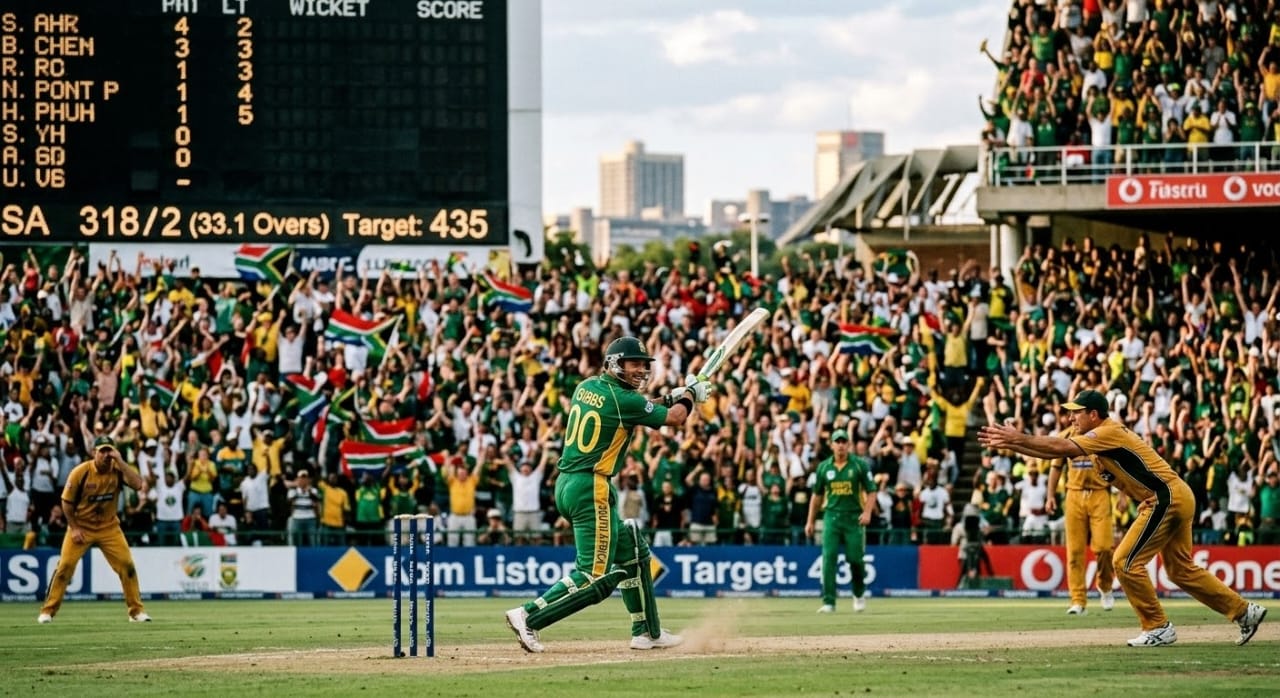
The "438 Match"
On March 12, 2006, at the Wanderers Stadium in Johannesburg, Australia broke world records by scoring an unprecedented 434/4 in 50 overs, led by Ricky Ponting’s explosive 164. The match seemed over before the innings break.
What followed defied all tactical wisdom. South Africa, anchored by Herschelle Gibbs' breathtaking 175 off 111 balls, chased down the total with one ball and one wicket to spare, finishing on 438/9
Tactical Shift in Limited-Overs History
The 438 match altered how teams perceived targets in limited-overs cricket. It smashed psychological barriers regarding score capabilities, directly influencing the mindset required for the T20 revolution that followed just a few years later. It proved no target was safe and changed how teams approached run-chases forever.
Summary of Historical Matches
MatchYearKey FiguresHistorical Significance
England vs. Australia1882Fred Spofforth, A.N. HornbyBirth of The Ashes; early Australian national identity.
Australia vs. England1933Douglas Jardine, Don BradmanDiplomatic crisis; rewrite of dangerous bowling rules.
England vs. West Indies1950Sonny Ramadhin, Alf ValentineImperial defeat; rise of post-colonial Caribbean pride.
India vs. Pakistan1987Gen. Zia-ul-Haq, Rajiv Gandhi"Cricket Diplomacy" that averted border conflict.
India vs. South Africa1991Clive Rice, Kapil DevRe-entry of South Africa into global sport post-Apartheid.
South Africa vs. Australia2006Herschelle Gibbs, Ricky Ponting
Conclusion
Cricket is far more than leather striking willow across grass. It is a contest where geopolitics, anti-colonial struggles, racial liberation, and tactical innovations converge. From the birth of the Ashes at The Oval to the diplomacy at Bangalore, these pivotal matches proved that what happens inside the 22-yard pitch can resonate far beyond the boundaries of the stadium.

You must be logged in to post a comment.