

From Chatbots to Digital Workers: How Agentic AI Is Quietly Replacing Human Jobs in 2026
Introduction
Artificial Intelligence has moved far beyond simple automation. Just a few years ago, businesses were excited about chatbots answering customer questions or algorithms helping with data analysis. But in 2026, a far more powerful shift is unfolding—Agentic AI.
Unlike traditional AI systems that wait for human instructions, Agentic AI systems act independently, make decisions, and complete complex tasks from start to finish. These AI agents can research, write reports, manage workflows, respond to customers, and even collaborate with other AI agents.
In many industries, companies are quietly replacing entire job roles with digital workers powered by AI agents. The transformation is happening faster than most people realize.
While businesses celebrate increased productivity and lower costs, workers across the globe are asking a difficult question:
Are humans being slowly replaced by intelligent machines?
This article explores how Agentic AI is transforming the workplace in 2026, which jobs are most at risk, which careers are safest, and what this shift means for the future of human employment.
What Is Agentic AI?
The Evolution of Artificial Intelligence
Artificial Intelligence has evolved in several stages:
1. Rule-Based Automation
Simple scripts
Predefined workflows
No learning ability
2. Machine Learning Systems
Pattern recognition
Predictive analytics
Data-driven decisions
3. Generative AI
Content creation
Image, text, and code generation
Conversational interfaces
4. Agentic AI (The Current Revolution)
Agentic AI represents a major leap forward.
Instead of performing single tasks, AI agents can:
Set goals
Plan steps
Execute tasks
Adapt based on results
Work continuously without supervision
This allows AI to function more like a digital employee rather than a simple tool.
What Makes Agentic AI Different?
Agentic AI systems have several powerful capabilities:
1. Autonomous Decision-Making
These systems can analyze situations and decide the best course of action without human input.
2. Multi-Step Task Execution
Agentic AI can perform complex workflows, such as:
Researching a topic
Writing a report
Designing visuals
Publishing content
Analyzing audience data
All automatically.
3. Continuous Learning
AI agents constantly improve by analyzing feedback and outcomes.
4. Collaboration Between AI Agents
Multiple AI agents can work together to complete large projects.
For example:
One AI researches
Another writes
Another edits
Another publishes
Together they form a digital workforce.
The Rise of Digital Workers
What Are Digital Workers?
Digital workers are AI agents designed to perform specific job roles traditionally done by humans.
These agents can:
Handle customer service
Manage marketing campaigns
Process financial reports
Write code
Analyze legal documents
Coordinate logistics
Unlike humans, they:
Work 24/7
Never take breaks
Cost far less
Scale instantly
This makes them extremely attractive for businesses.
Why Companies Are Rapidly Adopting AI Workers
Several factors are accelerating the rise of AI employees.
Lower Costs
Hiring human workers involves:
Salaries
Benefits
Training
Office space
AI workers eliminate most of these expenses.
Higher Productivity
AI can complete tasks much faster than humans.
For example:
Data analysis in seconds
Reports generated instantly
Customer support replies in milliseconds
Scalability
Businesses can deploy thousands of AI agents instantly.
Human teams cannot scale this quickly.
Global Competition
Companies that adopt AI gain a massive productivity advantage.
This creates pressure for competitors to follow.
Jobs Already Being Replaced by AI in 2026
Agentic AI is already transforming several industries.
Some job categories are experiencing rapid automation.
Customer Support Representatives
Customer service was one of the earliest roles impacted by AI.
Today’s AI agents can:
Answer complex questions
Troubleshoot issues
Process refunds
Track orders
Escalate rare cases
Many companies now use AI support teams instead of human agents.
Impact
Millions of call center jobs are declining worldwide.
AI customer support now handles 80–90% of requests in many companies.
Content Writers and Copywriters
Generative AI tools now create:
Blog posts
Marketing copy
Product descriptions
Social media content
Email campaigns
Agentic AI goes further by managing entire content strategies.
AI can now:
Research trending topics
Write articles
Optimize SEO
Schedule posts
Analyze performance
This automation is rapidly changing the content industry.
Data Analysts
Data analysis used to require specialized professionals.
Now AI agents can:
Process large datasets
Generate insights
Create dashboards
Write summaries
Businesses increasingly rely on AI analytics assistants instead of human analysts.
Administrative Assistants
Many office tasks are now automated.
AI assistants can handle:
Email management
Meeting scheduling
Travel planning
Document creation
Workflow organization
These digital assistants are replacing many traditional office roles.
Entry-Level Programmers
Coding AI systems can now:
Generate software code
Fix bugs
Test applications
Suggest improvements
This reduces demand for junior developers.
However, experienced engineers are still needed to supervise complex systems.
Industries Being Transformed by Agentic AI
Agentic AI is not limited to tech companies.
Nearly every industry is experiencing disruption.
Finance
AI agents now manage tasks like:
Fraud detection
Risk analysis
Investment recommendations
Compliance monitoring
Financial institutions use AI to process massive volumes of transactions.
Healthcare
AI digital workers assist with:
Medical documentation
Patient scheduling
Diagnostic analysis
Research reviews
Doctors still make final decisions, but AI handles many administrative tasks.
Marketing
Marketing teams now rely heavily on AI agents.
AI can automatically:
Create campaigns
Analyze customer behavior
Optimize advertisements
Run A/B tests
Generate personalized messages
This drastically reduces the need for large marketing teams.
E-Commerce
Online stores use AI agents to:
Manage inventory
Optimize pricing
Recommend products
Handle customer inquiries
Predict demand
This creates more efficient digital marketplaces.
The Hidden Job Crisis
Why the Impact Is Happening Quietly
Unlike previous industrial revolutions, AI job displacement is happening silently.
Companies rarely announce:
“AI replaced our employees.”
Instead, they:
Stop hiring new workers
Gradually reduce staff
Automate workflows internally
This makes the shift less visible—but equally powerful.
The Most Vulnerable Jobs
Jobs at highest risk typically involve:
Repetitive tasks
Predictable workflows
Digital information processing
Examples include:
Data entry clerks
Customer support agents
Basic accounting roles
Telemarketing
Transcription services
These roles are easier for AI to automate.
Jobs That AI Cannot Easily Replace
Despite rapid progress, many professions remain relatively safe.
These jobs require human creativity, empathy, or physical presence.
Creative Professionals
AI can assist creativity but rarely replaces original human vision.
Safer roles include:
Film directors
Artists
Creative strategists
Designers
Human storytelling still holds strong value.
Healthcare Professionals
Doctors, nurses, and therapists rely heavily on:
Human judgment
Emotional intelligence
Ethical decision-making
AI acts as a tool rather than a replacement.
Skilled Trades
Jobs requiring physical skill remain difficult to automate.
Examples include:
Electricians
Plumbers
Construction workers
Mechanics
Robotics has not yet replaced these professions at scale.
Leadership and Strategy Roles
Executives and managers make complex decisions involving:
Ethics
People management
Long-term planning
AI can provide insights, but human leadership remains essential.
The Rise of AI-Human Collaboration
The Future Is Not Just Replacement
While some jobs disappear, new ones are emerging.
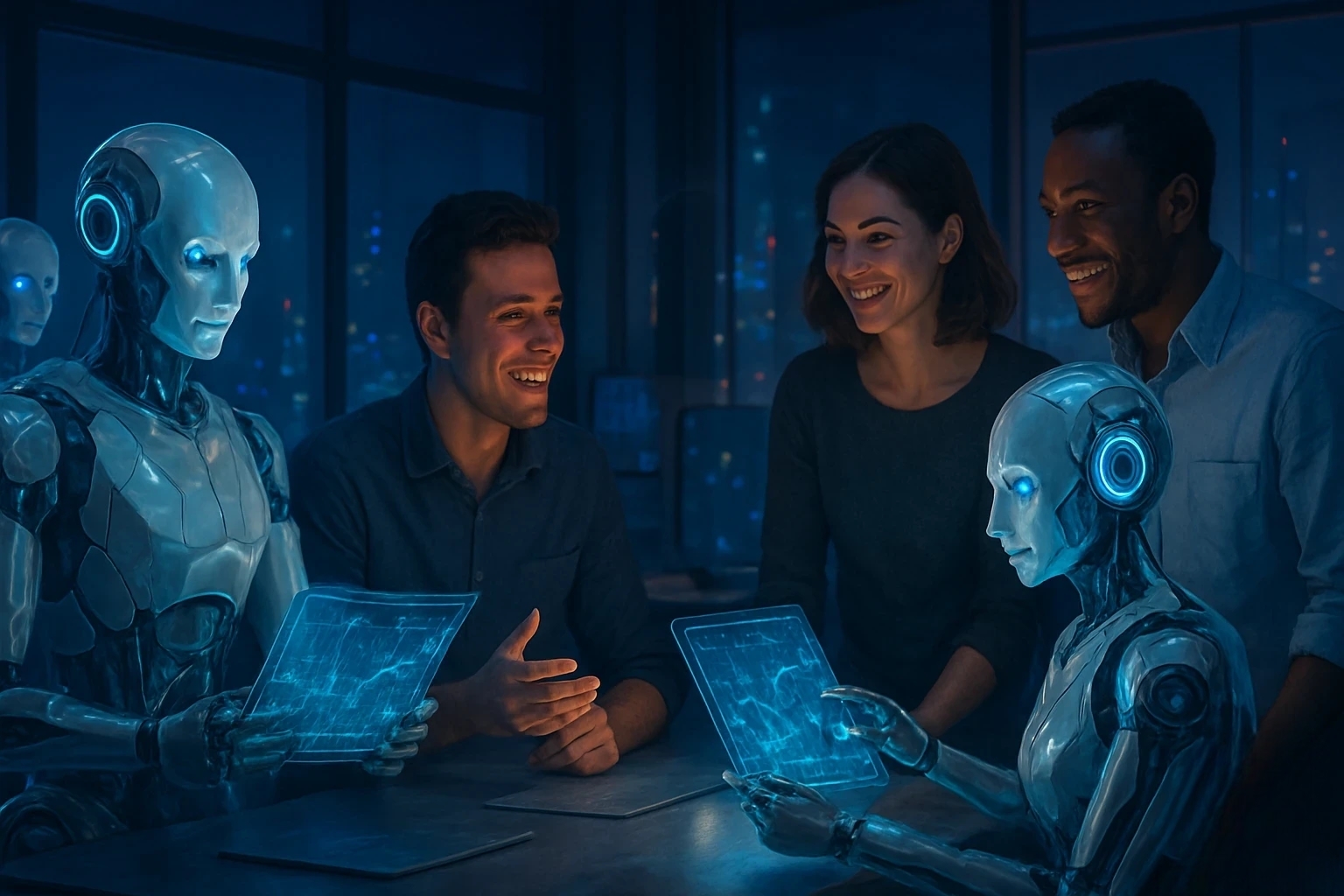
Instead of replacing humans completely, many companies are building AI-human hybrid teams.
Humans now work alongside AI agents.
New Careers Emerging in the AI Economy
Several new job categories are growing rapidly.
AI Trainers
These professionals teach AI systems how to perform tasks effectively.
AI Workflow Designers
They design processes where humans and AI collaborate.
Prompt Engineers
Experts who guide AI systems to produce high-quality outputs.
AI Ethics Specialists
These professionals ensure AI systems operate responsibly.
Ethical Concerns Around AI Workers
The rise of Agentic AI raises serious questions.
Mass Unemployment Risks
If AI adoption accelerates rapidly, millions of jobs could disappear.
Economists debate whether new jobs will appear quickly enough.
Economic Inequality
AI may concentrate wealth among:
Large technology companies
Investors
AI developers
Meanwhile, displaced workers could struggle.
Accountability Issues
If AI makes mistakes, who is responsible?
Possible stakeholders include:
The company using AI
The developers who built it
The organizations that trained it
Governments are still developing regulations.
Government Responses to AI Job Disruption
Countries are beginning to respond to the AI revolution.
AI Regulation
Governments are exploring laws related to:
AI transparency
Worker protection
Data privacy
Automated decision-making
Education and Reskilling
Many governments encourage workers to learn new skills.
Popular reskilling programs focus on:
AI literacy
Data science
Cybersecurity
Digital creativity
Universal Basic Income (UBI)
Some experts suggest Universal Basic Income as a solution.
This system would provide citizens with a guaranteed income regardless of employment.
While controversial, the idea is gaining attention as automation expands.
How Workers Can Survive the AI Era
The key to surviving the AI revolution is adaptation.
Workers who embrace technology rather than resist it will have an advantage.
Learn AI Tools
Understanding AI tools can make workers far more productive.
Popular skills include:
AI content tools
Data analysis platforms
Automation software
Focus on Human Skills
AI struggles with uniquely human abilities such as:
Creativity
Emotional intelligence
Leadership
Complex problem-solving
Developing these skills can protect careers.
Become an AI Collaborator
Instead of competing with AI, workers can learn to manage and direct AI systems.
Those who master AI tools may become the most valuable professionals of the future.
The Future of Work in an AI-Driven World
The workplace of the future will likely look very different.
Experts predict:
Smaller human teams
Large networks of AI agents
Highly automated workflows
Humans may shift toward:
Creativity
Strategy
Innovation
Relationship-building
While AI handles repetitive tasks.
Conclusion
Agentic AI represents one of the most transformative technologies in modern history.
What began as simple chatbots has evolved into autonomous digital workers capable of performing entire job roles.
In 2026, businesses are rapidly adopting these AI agents to reduce costs, increase productivity, and stay competitive.
For workers, this shift creates both fear and opportunity.
Some jobs will disappear, but new careers will emerge in the evolving AI economy.
The most successful people in the coming decade will not be those who resist AI—but those who learn how to work with it.
As Agentic AI continues to advance, society faces a critical challenge:
How do we harness the power of intelligent machines while protecting the future of human work?
The answer will shape the global economy for decades to come.

You must be logged in to post a comment.