


Most people who study English for years and still cannot hold a conversation are not lacking effort. They are doing the wrong activities with the right effort. Grammar exercises and vocabulary lists produce a student who can pass a test and cannot order a coffee.
What follows is the set of activities that produce visible progress in weeks rather than years, ordered by how much they change your actual ability.
Why Learners Stall
Two reasons. The first is that study feels like progress but is not transferable. Knowing a rule is not the same as using it under pressure, and no amount of knowing prepares you for the speed of real conversation.
The second is that learners avoid the one activity that works: speaking. Speaking is uncomfortable, error-prone, and impossible to control. It is also the only way to become fluent, and fluency is the goal.
The Top 10 Tips
1. Speak Out Loud Every Day
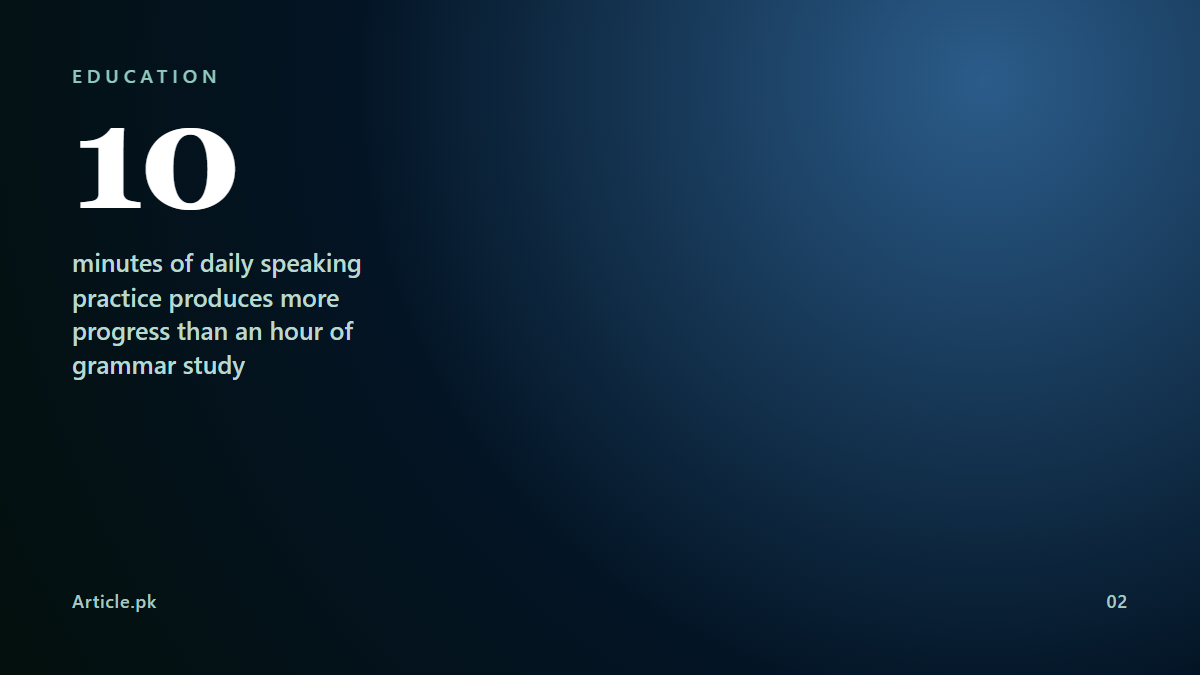
Ten minutes, alone, about anything. Describe your day, narrate what you are doing, explain a topic you know. The point is to make your mouth produce English without preparation.
Silent study does not transfer to speech. Only speech does.
2. Read What You Actually Enjoy
Not textbooks. Stories, articles, sports coverage, whatever you would read in your own language. Comprehension and vocabulary grow fastest when the material is interesting enough to keep you reading.
Look up words only when they block meaning. Otherwise keep reading.
3. Listen Actively, Not Passively
Watching shows with subtitles in your own language is entertainment, not practice. Listen to podcasts at a level slightly above your comfort, and replay the parts you missed.
Shadowing — repeating what you hear half a second behind the speaker — is the fastest single method for pronunciation and rhythm.
4. Record Yourself Weekly
Speak for two minutes on a topic and listen back. The gap between how you think you sound and how you actually sound is the single most useful feedback available, and it is free.
Compare recordings month to month. The change is visible when daily progress is not.
5. Learn Phrases, Not Words
A vocabulary list of isolated words produces someone who knows thousands of words and cannot construct a sentence. Phrases and collocations — how words actually sit together — produce fluency.
Learn \"make a decision\" as a unit, not \"make\" and \"decision\" separately.
6. Stop Translating in Your Head
Translation is a crutch that slows you down and produces unnatural English. When you hear a word, associate it with an image or a feeling rather than with its equivalent in your language.
This takes months but it is the difference between intermediate and fluent.
7. Write Short and Often
A paragraph a day in English, on anything. Writing forces you to notice the gaps in your vocabulary and grammar that speaking lets you skip.
Do not write essays. Write the kind of message you would actually send.
8. Make Mistakes on Purpose
Use a word you are unsure about. Try a tense you have not mastered. The feedback from being wrong teaches faster than avoiding the situation entirely.
Native speakers make mistakes too. The difference is they do not stop.
9. Find One Conversation Partner
One person, twice a week, for thirty minutes. A language exchange, a tutor, a colleague. The point is regularity and the slight discomfort of being understood.
Group classes are useful for beginners and counterproductive for intermediate learners.
10. Think in English
Describe your surroundings in your head. Plan your day in English. The internal monologue is where fluency is actually built, because it is the practice you do when no one is watching.
Start with ten minutes a day and extend it.
What to Stop Doing
Stop memorising grammar rules you cannot use. Stop studying vocabulary lists without context. Stop watching shows with subtitles in your own language. And stop waiting until you feel ready, because readiness is a feeling that never arrives.
The students who improve fastest are the ones who are willing to sound foolish for a month. That willingness is the entire skill.
How to Measure Progress
Progress in language learning is invisible day to day, which is why most people quit after three weeks. The fix is to measure something specific and compare it monthly rather than daily.
Record yourself speaking for two minutes on the same topic on the first of every month. Keep the recordings. After three months the difference is audible and undeniable, and that evidence carries you through the next three months.
Count the words you looked up in a week of reading. The number drops steadily as your vocabulary grows, and the drop is a more reliable measure than any test score.
And track one conversation: how long you could keep it going before switching to your own language. That number rises slowly and then suddenly, which is the pattern of all language acquisition.

The Realistic Timeline
At ten minutes of speaking a day, a beginner reaches basic conversation in roughly three to six months. Intermediate to fluent takes longer, roughly a year of consistent practice, because the remaining gaps are subtle rather than obvious.
The difference between someone who reaches fluency and someone who does not is almost never talent. It is the willingness to speak badly for longer than feels comfortable, and most people abandon this around week four.
There is no shortcut. Apps that promise fluency in thirty days are selling a feeling of progress, not progress itself. The feeling is real; the progress is not, and the gap between the two is where the money goes.
What you can accelerate is the amount of speaking you do per day. A student who speaks for an hour a day reaches in months what a student speaking for ten minutes reaches in a year. The ratio holds.
The Bottom Line
Speak out loud daily, read what you enjoy, and record yourself monthly. Fluency is built by the mouth, not by the textbook.
One more habit worth keeping: read one page of something difficult every day. Not for vocabulary, but for the experience of not understanding and continuing anyway. That tolerance for ambiguity is what separates someone who speaks English from someone who has studied it.








Comments 0
Sign in to join the conversation.
No comments yet. Be the first to say something.