

Every year, thousands of capable Pakistani students give up on university because of fees. Many more never apply for a scholarship because they assume the competition is impossible or the paperwork is too confusing. Neither is true. Funding is available at every level, from undergraduate stipends to fully funded PhDs abroad, and the students who win it are usually the ones who start early and follow the process carefully.
This guide covers the main scholarships for 2026, who qualifies, how to apply, and how to plan around deadlines.
The Three Types of Scholarships
Scholarships for Pakistani students fall into three groups. Fully funded awards cover tuition, living costs, travel and health insurance. Partially funded awards cover tuition only or a fixed amount. Need-based awards depend on family income rather than grades.
Knowing which type you are targeting shapes your whole application. Merit awards reward grades and achievements. Need-based awards reward documented financial hardship. Many students qualify for both and should apply to both.
1. HEC Need-Based Scholarship (Undergraduate)
This is the largest local program for students who cannot afford fees. It is the biggest undergraduate scholarship program for students at public universities. Universities run the process themselves, so announcements come from your institution, not from a single national portal. Need-based scholarships are announced by the universities.
Who is eligible:
Students admitted on merit to an undergraduate program at a participating university
Students from low-income families who can document their financial position
Students enrolled in a regular, full-time degree program
Typical documents: CNIC or B-Form, domicile, income proof or salary slips, utility bills, academic transcripts, and an admission letter or fee challan.
Deadlines: These vary by university and change often. For example, one public university extended its deadline for the 2025-26 cycle to 15 April 2026. A different campus gave 15 October 2026 as the cutoff for Fall 2026 forms. Do not rely on a single national date. Check your own university’s scholarship office.
2. HEC Overseas and International Scholarships
HEC also nominates Pakistani students for fully funded study abroad. The Fulbright, Commonwealth and Chinese Government programs are the best known. The Commonwealth scholarship is a postgraduate program with HEC nomination for UK universities. For the Chinese Government Scholarship, one listing gave the HEC portal deadline as 5 January 2026 and stated that both the HEC and CSC applications are mandatory. That cycle has closed, but it shows how these programs work. They run on strict annual calendars and require two separate applications. Expect the next cycle to open in the final months of the year or early in the next, and watch the HEC website for the notice.
Typical eligibility:
A strong academic record, usually a first division or a CGPA above 3.0
Relevant degree requirements for the level you are applying to
Age limits, which differ by program
Provincial and Welfare Scholarships
Provincial and federal bodies run a large set of programs aimed at low-income families and government school students.
Ehsaas Undergraduate Scholarship: One guide describes it as covering 100% tuition plus a PKR 4,000 monthly stipend for low-income students at public universities. Eligibility follows BISP-type income criteria. opportunityinside
Dalda Foundation Scholarship: A listing says the cycle typically opens in August or September with a deadline around 31 October. opportunityinside
Honhaar (Punjab) and the Sindh Education Foundation program: These target students from government schools and underprivileged backgrounds in their provinces.
Worker welfare schemes such as the Punjab Workers Welfare Fund’s talent scholarships: These are aimed at children of registered workers.
Treat the deadlines on aggregator sites as starting points, not facts. Several of the dates above come from third-party listings that were compiled before the cycles opened, and listings often disagree. Always confirm the date on the official website of the organization that awards the scholarship.
International Programs Pakistani Students Win Every Year
Beyond HEC nominations, these programs accept direct applications and regularly fund Pakistanis: DAAD (Germany), Chevening (UK), Türkiye Burslari (Turkey), MEXT (Japan), GKS (Korea) and Australia Awards. Most of these target students from developing countries, and Pakistan qualifies for all of them. The usual obstacle is preparation, not eligibility.
How to Apply: A Step-by-Step Process
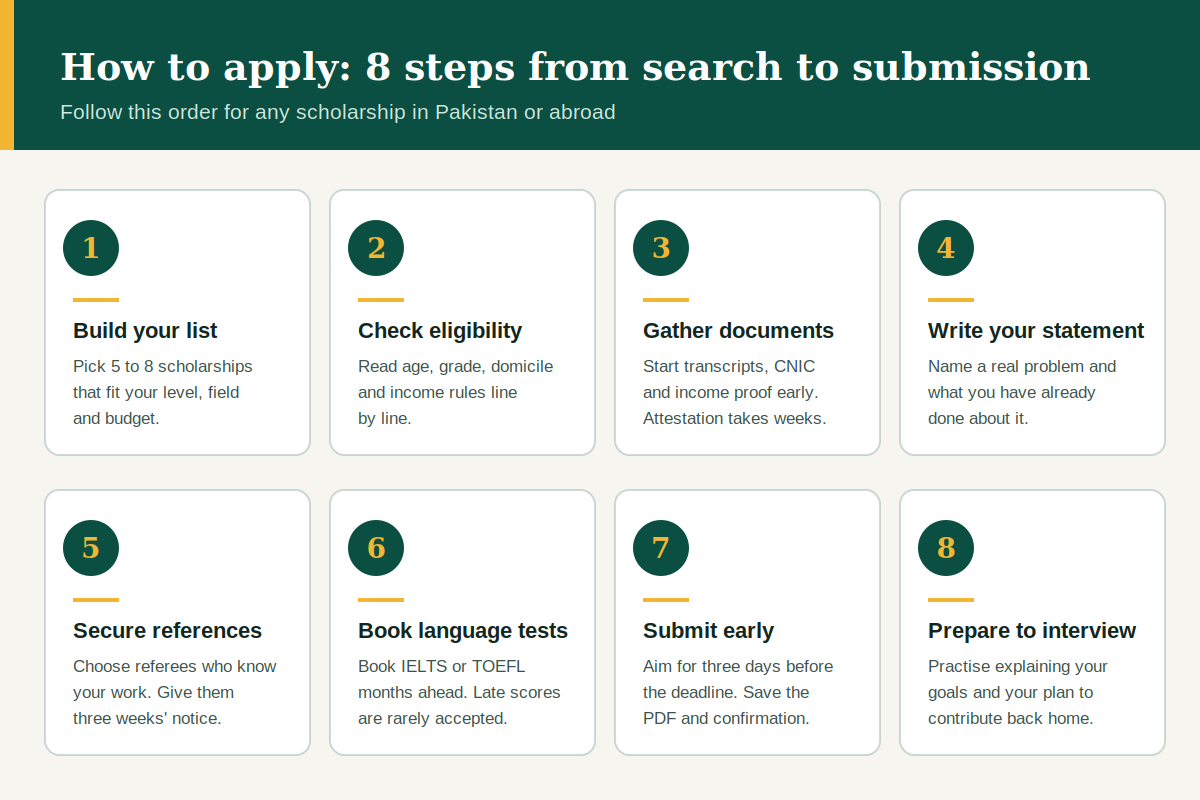
Step 1: Build your target list. Choose five to eight scholarships that match your level, field and finances. Include at least two local options as a safety net.
Step 2: Check eligibility line by line. Read the criteria for age, degree, grades, nationality, domicile and income. One missed requirement disqualifies an otherwise strong application.
Step 3: Gather documents early. Degree certificates, transcripts and attested copies take weeks to arrange. Income certificates and recommendation letters take longer. Start before the announcement, not after it.
Step 4: Write a focused statement of purpose. Committees read hundreds of essays. Winning ones are specific. They name a problem you care about, show what you have already done about it, and explain how this degree moves you forward. Avoid generic lines about “serving humanity.”
Step 5: Secure strong references. Pick referees who know your work well. Give them your resume, the scholarship details and at least three weeks’ notice.
Step 6: Prepare for language tests. If IELTS or TOEFL is required, book your exam months ahead. Many scholarships will not accept a late score.
Step 7: Submit early and keep proof. Portals slow down or crash near deadlines. Submit at least three days early, save a PDF of your submission, and keep the confirmation email.
Step 8: Prepare for interviews. Shortlisted candidates face panel interviews. Practice explaining your goals, your field and your plan to return and contribute.
Common Mistakes That Cost Students Their Scholarship
Applying on the last day and hitting a portal failure
Submitting incomplete or unattested documents
Using one generic essay for every program
Relying on social media posts instead of the official notice
Ignoring local scholarships because they seem less glamorous, even though competition is often lower
Beware of Scams
Real scholarships do not charge application fees to a personal account or ask for your bank PIN. Legitimate HEC and university announcements come through official websites and verified social media pages. If an offer arrives by WhatsApp message promising guaranteed selection, treat it as a scam.
A Simple Yearly Calendar
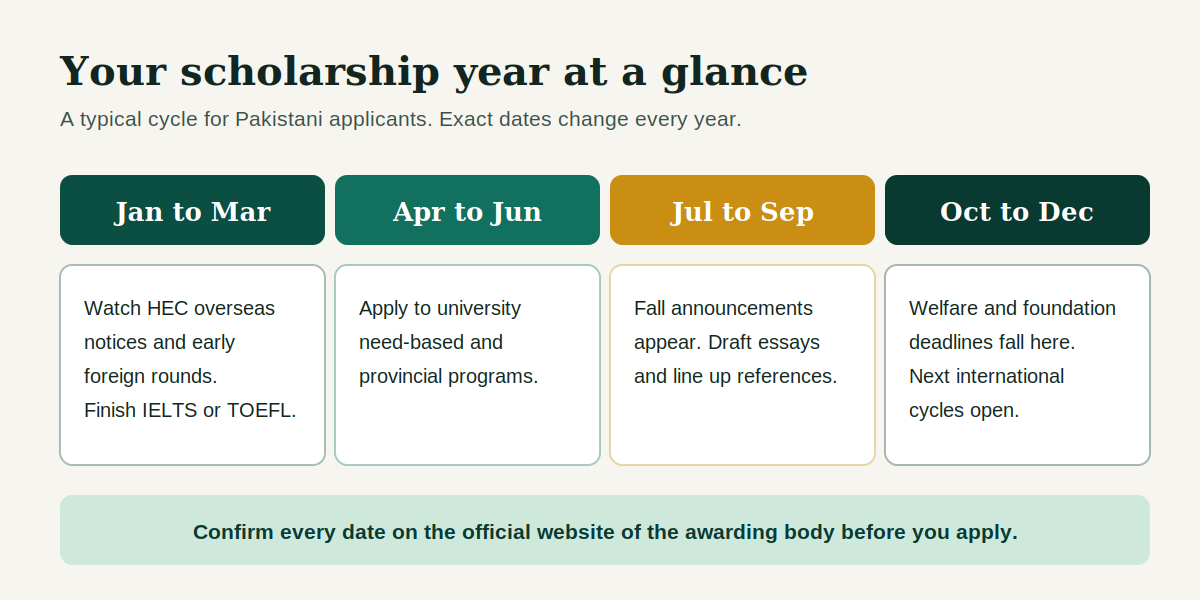
January to March: Watch for HEC overseas announcements and early foreign scholarship rounds. Finish language tests.
April to June: Apply to university-level need-based scholarships and provincial programs.
July to September: Many fall-intake announcements appear. Prepare essays and references for foreign programs.
October to December: Several welfare and foundation deadlines fall here, and the next international cycles open.
Because the calendar changes each year, set alerts on the HEC website, your university’s scholarship page and the official sites of the programs you want.
Final Word
Scholarship success in Pakistan is rarely about being the single smartest applicant. It comes from starting early, matching your profile to the right programs, submitting complete documents and checking every date at the source. Pick your targets this week, start collecting documents, and treat every deadline as one you will meet a month early.
Note: Deadlines and eligibility rules change by cycle and by institution, and the sources I found conflicted on several dates. Verify each one on the official website before you apply.








Comments 0
Sign in to join the conversation.
No comments yet. Be the first to say something.