


How to Learn English Online for Free: A Beginner’s Guide
Introduction
English is one of the most useful languages in the world. It can help students continue their education, find better job opportunities, communicate with people from different countries, and access valuable information online. However, many beginners believe that learning English requires expensive courses, private teachers, or special books. This is not always true.
Today, the internet provides many free resources that can help people improve their English from home. With a mobile phone, laptop, and regular practice, anyone can begin learning English step by step. The most important things are patience, consistency, and a willingness to learn from mistakes.
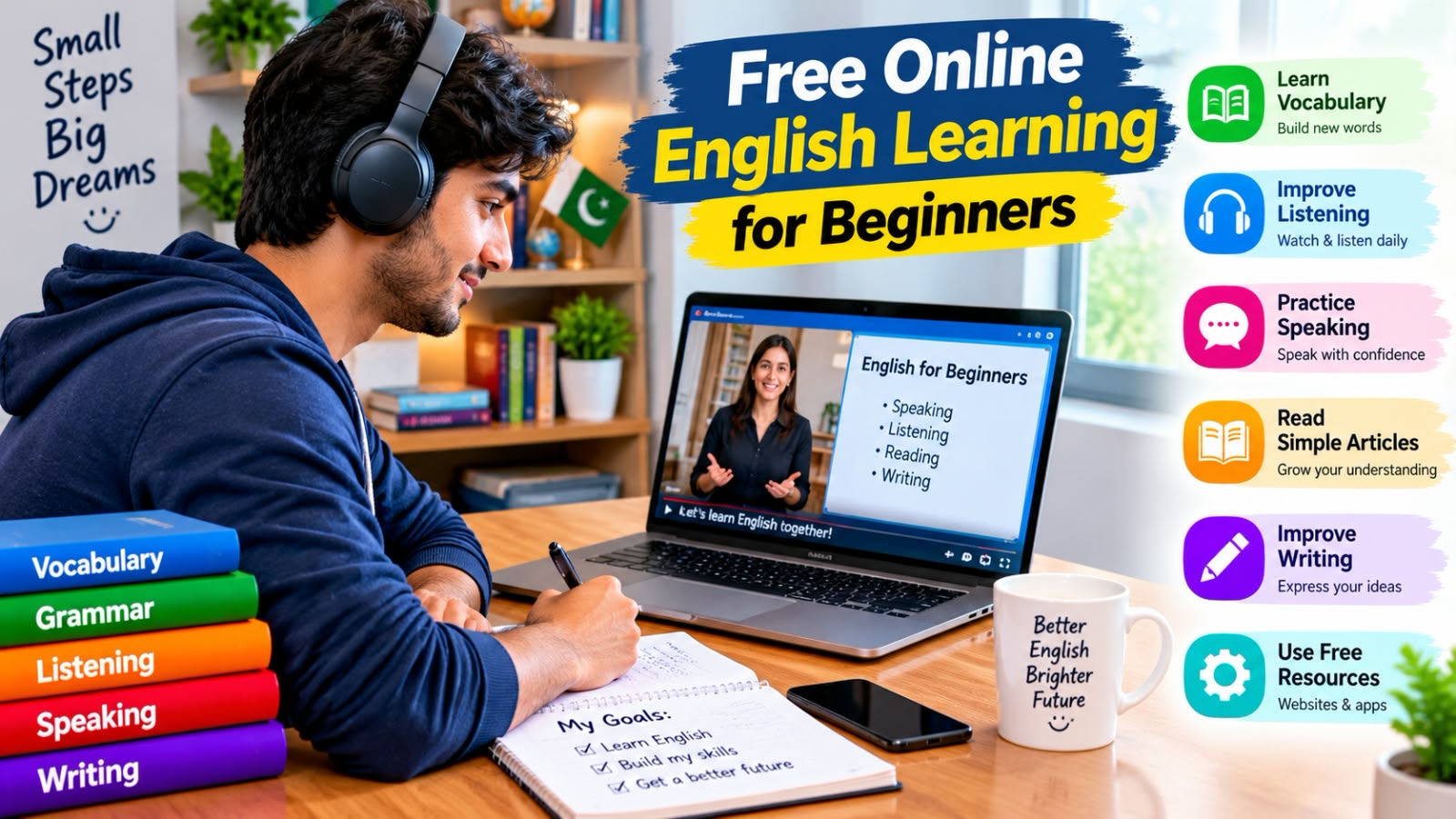
This guide explains practical ways beginners can improve their English speaking, listening, reading, and writing skills without spending money.
1. Start With Basic English Words
Beginners should start by learning common English words used in everyday life. Do not try to memorise hundreds of difficult words in one day. Instead, learn around 5 to 10 useful words daily.
For example, begin with words related to family, food, education, work, shopping, and daily activities. Write each word in a notebook with its meaning and an example sentence.
For example:
- Learn: I want to learn English.
- Read: I read a book every day.
- Work: My brother goes to work.
- Happy: I am happy today.
- Help: Can you help me?
Try to use newly learned words in your own sentences. This makes it easier to remember them and understand how they are used in real conversations.

2. Improve Your English Listening Skills
Listening is an important part of learning any language. Beginners should listen to simple English conversations, short educational videos, and beginner-level stories.
YouTube offers many free English-learning lessons. Search for beginner English conversations, English listening practice, and simple English stories.
At first, you may not understand every word. That is normal. Listen to the same short conversation more than once. Try to understand the main idea before focusing on individual words.
Another useful method is to listen to a sentence and repeat it aloud. This helps you become familiar with pronunciation, sentence structure, and natural speaking speed.
3. Practise Speaking Every Day
Many learners understand written English but feel nervous when speaking. The best way to improve speaking is to practise regularly.
You do not need a professional teacher to begin. Start by speaking simple sentences about your daily routine.
For example:
- My name is Ahmed.
- I live in Pakistan.
- I am learning English.
- I use the internet for education.
- I want to improve my communication skills.
You can also practise speaking in front of a mirror. Choose a simple topic, such as your family, school, favourite food, or daily activities. Speak for one or two minutes.
Do not worry too much about grammar mistakes. Mistakes are a normal part of learning. Focus on becoming more comfortable expressing your thoughts.
4. Read Simple English Articles and Stories
Reading helps you understand vocabulary, grammar, and sentence structure. Beginners should choose short and easy reading materials instead of complicated books.
You can read free educational articles, short stories, children's stories, and beginner English lessons online.
While reading, follow these steps:
1. Read the complete paragraph slowly.
2. Identify words you do not understand.
3. Check their meanings in a dictionary.
4. Write down useful new words.
5. Read the paragraph again.
Try to read for 10 to 15 minutes every day. Regular reading can gradually improve your understanding and make English sentences easier to recognise.
5. Improve Your English Writing Skills
Writing is another important skill. It helps learners organise their thoughts and understand how English sentences work.
Start with short paragraphs about familiar topics. You can write about your daily routine, hobbies, education, family, or future goals.
For example, write five sentences about your day:
"I wake up early in the morning. I have breakfast with my family. I study English for twenty minutes. I use my laptop to learn new skills. I want to improve my future."
After writing, check your spelling, punctuation, and grammar. You can use free online dictionaries and grammar-learning resources to understand your mistakes.
Do not copy complete paragraphs from other websites. Write your own sentences and practise expressing your own ideas.
6. Use Free Online English Learning Resources
There are several useful websites and applications that provide free English-learning materials.
Some examples include:
- BBC Learning English: Provides English lessons, vocabulary, pronunciation, and listening practice.
- Duolingo: Offers beginner-friendly language exercises. Check the available free features.
- Cambridge Dictionary: Helps learners understand word meanings and pronunciation.
- British Council LearnEnglish: Provides reading, listening, grammar, and vocabulary activities.
These resources can support your learning, but you do not need to use all of them at once. Choose one or two that are easy to understand and practise regularly.
Always visit the official website or download applications from a trusted app store.
7. Learn Basic Grammar Step by Step
Grammar helps you make meaningful sentences. However, beginners should not try to learn every grammar rule immediately.
Start with simple topics such as:
- Nouns and pronouns
- Verbs and adjectives
- Present simple tense
- Past simple tense
- Future simple tense
- Basic sentence structure
For example:
Present: I study English.
Past: I studied English yesterday.
Future: I will study English tomorrow.
Practise making your own examples. Understanding a few basic rules and using them correctly is more useful than memorising many rules without practice.
8. Follow a Simple Daily Learning Schedule
A daily schedule makes learning easier and helps you stay consistent. Even 30 to 45 minutes of practice can be useful when you follow a clear plan.
Here is a simple routine for beginners:
- 10 minutes: Learn new vocabulary.
- 10 minutes: Listen to simple English conversations.
- 10 minutes: Read a short story or article.
- 10 minutes: Practise speaking.
- 5 minutes: Write a few sentences.
If you have more free time, you can increase each activity gradually. The goal is to practise all four major skills instead of focusing only on reading or grammar.
9. Avoid Common English Learning Mistakes
Many beginners stop learning because they expect quick results. Learning a language takes time, and progress may be slow at the beginning.
Avoid these common mistakes:
Trying to learn too much at once: Focus on a small number of words and topics each day.
Being afraid of mistakes: Mistakes help you understand what needs improvement.
Only watching videos: Watching lessons is useful, but you should also speak, read, and write.
Skipping daily practice: Studying regularly is better than practising for several hours only once a week.
Comparing yourself with others: Everyone learns at a different speed. Focus on your own improvement.
10. Stay Motivated and Track Your Progress
Motivation can change from day to day, so it is helpful to create small learning goals.
For example, your weekly goals could include learning 35 new words, reading three short stories, writing two paragraphs, and practising speaking for five minutes each day.
Keep a notebook to record what you have learned. At the end of every week, review your vocabulary and read your previous writing. You may notice that your sentences are becoming clearer and your understanding is improving.
Celebrate small achievements. Understanding a new conversation or writing a paragraph without help is a meaningful step forward.
Conclusion
Learning English online for free is possible when beginners use the right resources and practise consistently. You can improve your vocabulary, listening, speaking, reading, and writing skills with free websites, videos, dictionaries, and simple daily exercises.
You do not need to become fluent in a few days. Start with basic words, practise simple sentences, and gradually increase the difficulty of your lessons. Most importantly, stay patient and make English a regular part of your daily routine.
With time, effort, and consistent practice, you can build confidence and use English more effectively in education, work, and everyday communication.








Comments 0
Sign in to join the conversation.
No comments yet. Be the first to say something.